

The Importance of Dream and Speech Among the Wayuu (2/2)

The Wayuu are a transborder Indigenous nation inhabiting the region stretching between the Guajira Peninsula, at the northernmost tip of Colombia, and part of Venezuela’s Caribbean coast. The Wayuu take pride in their title as a “people never conquered.” What follows is an account of a journey across the desert undertaken alongside them during Easter 2026, offering an opportunity to explore certain aspects of their philosophy of travel.
In the second part of this chronicle on the Wayuu people, other aspects of the journey allow us to glimpse some essential features of Wayuu beliefs, presented here through observations on the importance they attach to dreams, on the one hand, and to the spoken word, on the other. A report from Colombia’s La Guajira.
Beyond the physical territory, embodied by the clan and anchored in the cemetery, another realm complements the first and is no less essential to the Wayuu spirit: that of dreams.
For the Wayuu, a dream is a revelatory vision. It is another form of consciousness that announces events to come, indicates which path to follow, conveys a message, or explains waking reality. Indeed, any Wayuu person who is reasonably familiar with the language and culture will quite naturally ask, upon waking, by way of greeting those they first encounter after getting out of bed: Jamaya pulapüin? — “What did you dream?”
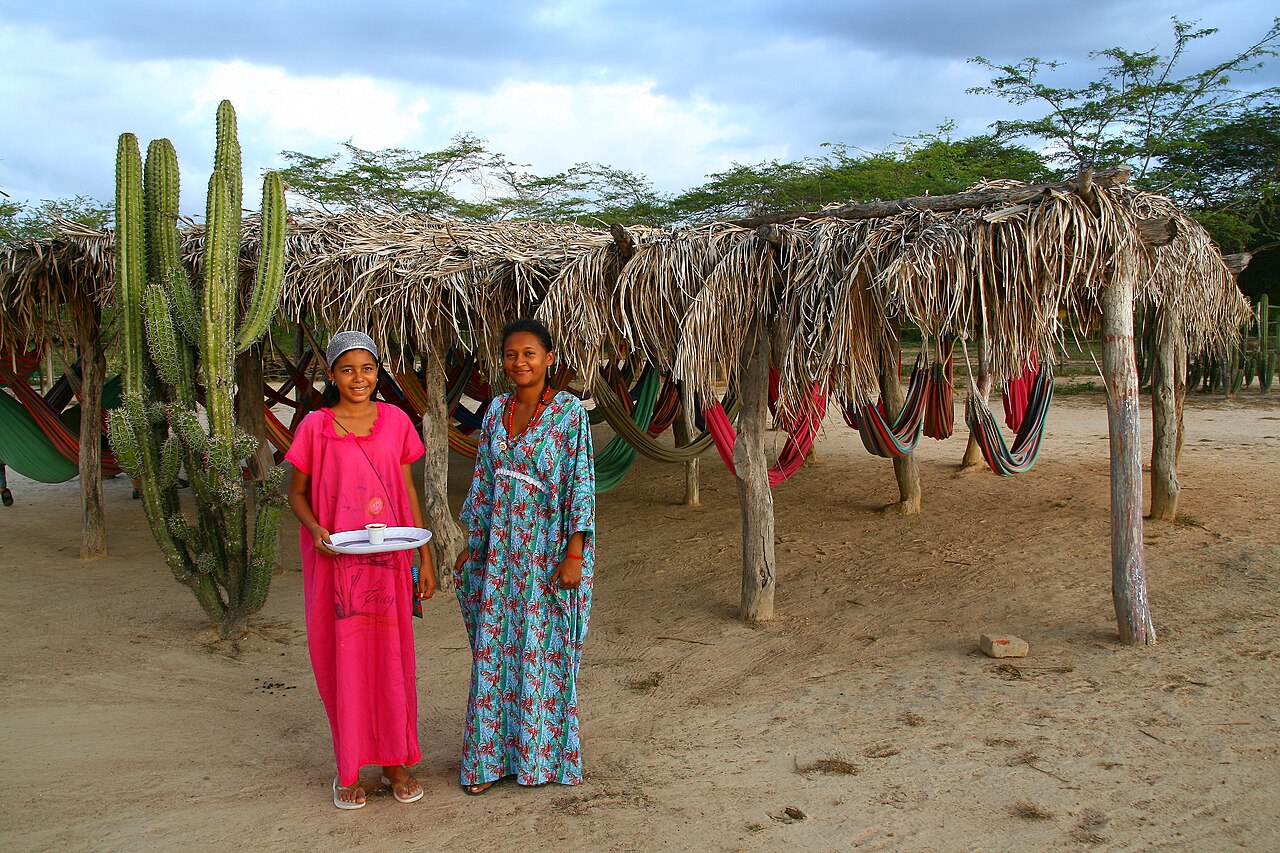
The suy, or chinchorro, the traditional hammocks. (Wikimedia Commons)
At the northernmost tip of La Guajira, in the sanctuary known as Talüwayüüpana, I spent a night sleeping in a suy, or chinchorro, the traditional hammock, alongside Paola and around fifteen other people who had invited me to attend a ritual.
At sunrise, as everyone awoke naturally with the first rays of light, they began telling one another about their dreams before going to see the mayor, the elderly keeper of knowledge who was part of our group and who interpreted each dream individually.
“*Ajá*… I saw a little girl in my dream,” one of those attending the ritual told the sabedor. “She was standing in front of me, in that direction, toward the sea, toward where the sun had set. She turned around and began to run. I followed her and tried to catch up with her. That was my dream.”
After a moment’s reflection, the elder replied: “She was probably showing you a water source. There are many forgotten springs around here, for your herd.” “And the girl?” “Many spirits are present in this region.”
What stands out in this dream is the role played by the little girl. The corollary of the dream is the spirit. The presence of the spirits of the dead or of Nature lies behind most significant dreams, along with certain signs they leave behind. Dreams are the realm of communication par excellence with these other elements of reality.
The sacrifice of goats
The ritual I was fortunate enough to attend was, in a sense, the waking counterpart of the dream, allowing communication with the spirits in another way. These spirits include Nature — a category that exists for us largely because of its opposition to Culture, whereas for the Wayuu the distinction between the two is far less clear-cut.
A sabedora and a sabedor first gathered us to witness the sacrifice of several goats.
While one man held the animals by the horns, the elder quickly thrust his knife into their throats and withdrew it. The animal was then released, spilling its blood as it made its final run before collapsing a few seconds later. Juya, the principal god of rain, was satisfied by this red flow.
Once night had fallen, with the full moon as our only source of light, the female keeper of knowledge gathered us in a circle and performed a limpieza on each of us: a purification involving sprays of chinrrinchi spat from the mouth and prayers accompanied by strokes of plants.
Finally came the traditional sacred dance of the yonna, during which the woman wears facial paint and a large red veil, the color of the vermilion cardinal bird, a symbol of La Guajira.
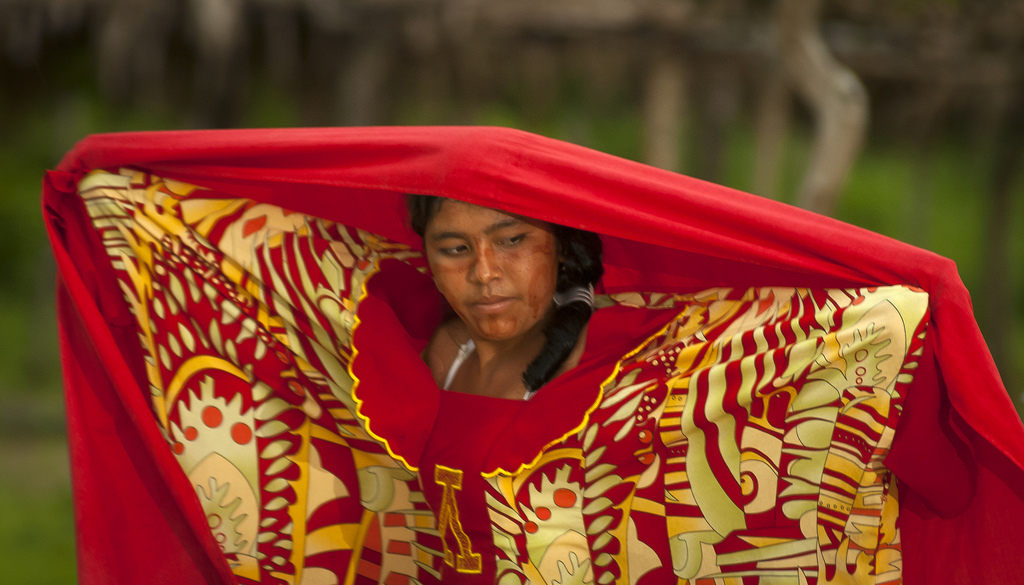
(Wikimedia Commons)
She dances while pursuing a man who hops backward in the opposite direction. Their steps imitate Nature: clouds, partridges, doves, horses. Although this dance has become a folkloric symbol for tourists willing to pay handsomely to see it, it is in fact a courtship dance and remains essential to any sacred event involving communication with the spirits and the Earth.
In truth, most dreams are rarely interpreted as happy omens. The Wayuu who seeks meaning in a dream often appears worried. Sleep frequently takes the form of a warning — foretelling an illness, for instance, or preparing someone for difficult weather conditions — or serves as protection against a malevolent spirit.
One final feature, revealing the intertwining of the sacred, the spirit world and dreams among the Wayuu, also recalls their attitude toward departure and travel.
At the end of the ritual, early in the morning, as we prepared to leave on our poor 150cc motorcycle to face the sandy, arid roads of the desert, I was about to turn around and give one last farewell wave to the gathering. But a woman who was also leaving and was walking just behind me spoke firmly:
“Don’t turn around. When you leave, you must never look back.”
The putchipuü and the art of the spoken word
What might be called Wayuu customary law — or, more accurately, the set of rules and roles shaping their unwritten normative system — is fascinating. So fascinating, in fact, that UNESCO inscribed it on its list of Intangible Cultural Heritage of Humanity in 2010.
The central figure in this system is the putchipuü, or palabrero: literally, the one who holds the word.
He is not appointed in the strict sense; his prestige is unanimously recognized by his clan and the community. His principal qualities are twofold. First, he knows the history, meaning, traditions and customs of the Wayuu. Second, he must possess a naturally thoughtful and peaceful disposition, enabling him to maintain wise detachment during conflicts — something that requires a calm temperament and a great ability to listen.
The title of putchipuü is not hereditary, although there are lineages of these messengers of the spoken word. A putchipuü often becomes one after growing up learning from and observing the attitudes of his predecessor, who may well be a close relative.
Take Neimer. Around thirty years old, he is remarkably knowledgeable about Wayuu traditions for a member of the younger generation. He is pursuing a master’s degree in “Mother Earth,” an Indigenous studies program at the University of Antioquia, which gives him an even deeper understanding of the “Wayuu spirit.”
Neimer has all the makings of a future putchipuü, and not without reason: since childhood he has followed in the footsteps of his father, a famous palabrero respected throughout Upper Guajira. It was thanks to Neimer, in fact, that I was able to attend the ritual held at the Stone of Destiny.
After nightfall, once the first sacrifice had been completed, Paola and Neimer told me to come closer. Around the circular track drawn in the sand for the sacred Yonna dance, the participants gathered in a circle.
One by one, everyone introduced themselves, giving their name, their clan and the reason for their presence. This was followed by a long opening speech from the putchipuü — the same elder who would interpret the dreams the following morning.
With Paola translating simultaneously, I could nevertheless sense the beautiful rhetorical forms characteristic of Wayuu eloquence and the rhythm of the jayeechi. For the putchipuü, this messenger, is a master of one of the cardinal values of Wayuu culture: the spoken word.
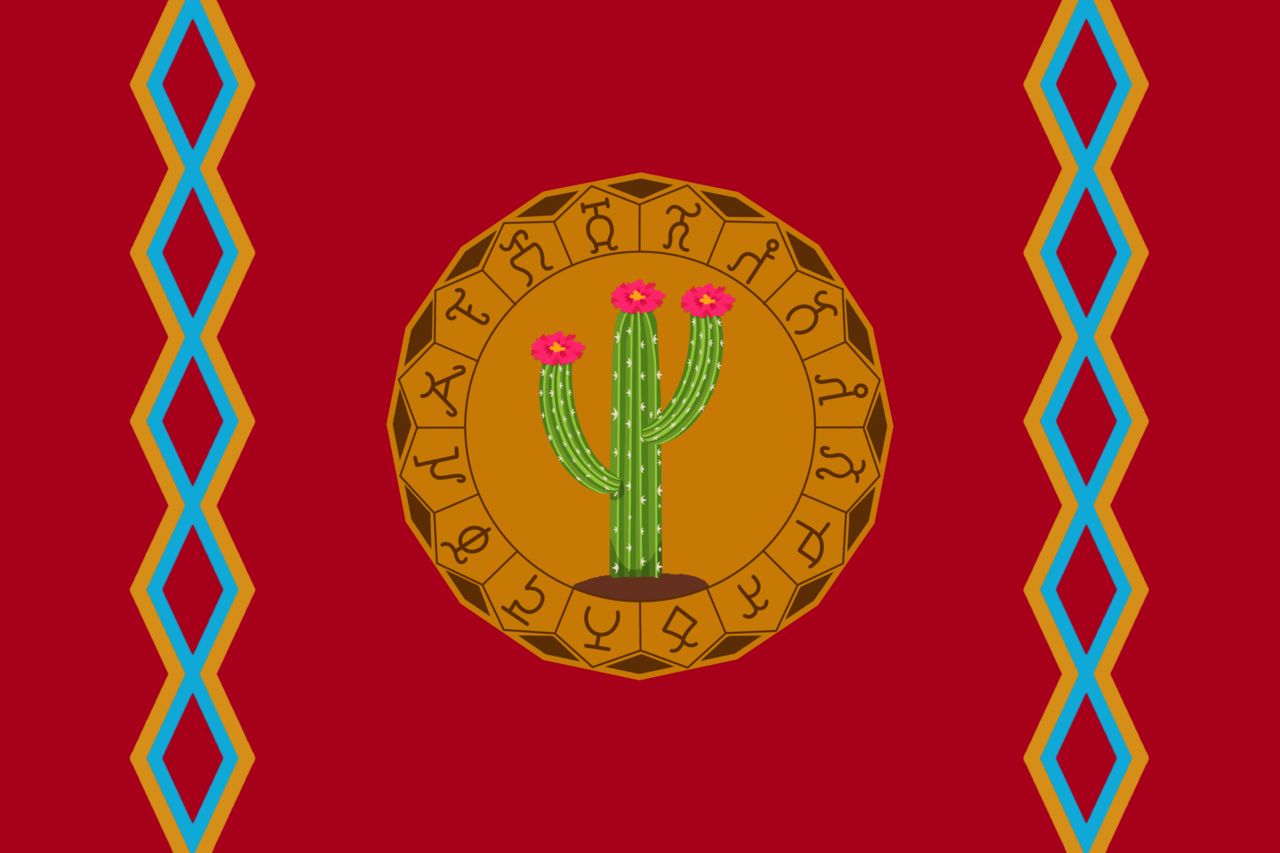
The Wayuu banner. (Wikimedia Commons)
During this solemn little gathering, punctuated by curls of smoke rising from the shared tabacos, our orator addressed a range of subjects, always illustrated by exemplary stories: what it means to be Wayuu, recalling the creation of the world according to their cosmology; the subject of love, recounting an unhappy episode from his youth and the conflict between two clans that followed; and finally, by way of an epilogue to the story, the importance of resolving disputes.
The putchipuü ended his speech with one of the most remarkable and subtle manifestations of Wayuu eloquence: a jayeechi.
It is an improvised — and therefore ephemeral — song-poem marking a particular moment, such as a gathering, a funeral vigil or a wedding. The jayeechi can also become a duel: a form of poetic jousting not unlike the Lebanese zajal.
From this anecdote about heartbreak, and particularly from the emphasis placed on the inter-family conflict that resulted, one can discern the most essential role of the putchipuü, mentioned at the beginning of this section: that of master of Wayuu “customary law,” endowed with the ability to bring peace to conflicts.
In his narrative and his jayeechi, our palabrero certainly evokes the moving memory of his personal experience as a Wayuu Majnun regretting his unattainable Layla.
Yet what emerges most clearly from the moral of this shared memory is the tragedy of seeing two families — and therefore two clans — tear one another apart and descend into confrontation.
For the Wayuu, the ultimate tragedy is the unraveling of bonds.
The solution in times of crisis is to find common ground through compensation or reparation from one party to another.
Proof of the primacy of the spoken word in Wayuu culture can be found in the expression locals use when threatening someone with being brought before the community’s customary law: Cuidao que te voy a mandar la palabra — “Watch out, or I’ll send you the Word!”
But the role of the putchipuü is not that of a judge. In a sense, the Wayuu have no judges. His function is that of an “ambassador,” whose task is to ease tensions and find a compromise.
When one clan has a grievance against another, the putchipuü of each side, acting as official representatives, speak on behalf of those gathered to deliberate.
This is not an improvised discussion; there are unwritten rules and sanctions.
An ordinary theft, for example, requires financial or material compensation worth four times the value of the stolen property, even if that property is returned.
It is important to understand that in such a judgment there is not merely an accuser and an accused, and once a decision has been reached, a victim and an offender.
The honor of the entire clan is at stake. Several family members therefore accompany the accused, and if wrongdoing is acknowledged, the offender must also repair the damage done to the honor of his clan.
It is a form of retributive and restorative justice that has received international recognition.
Epilogue: Time passes, memory remains
During the Easter season, in April, the land is cracked and dry.
“You should come back around Christmas. Everything is greener in La Guajira.”
Once a year, the rains flood large parts of the region. To ask someone’s age in Wayuunaiki, one says ¿Jeera puuyase?, which literally means, “How many rains have you seen?” — because heavy rains come only during a single period each year.
I realized that I had not seen a single ancient tomb, monument or old family relic among the Wayuu.
The rain, like the years, erases their memories.
Rain is passing time made visible, a reminder of the ephemeral: footprints in the sand, the passage of human beings. It washes the land, the blood of sacrifices, and drowns tears.
For the Wayuu, it eventually washes away even their dreams and their graves.
What remains are the stories — oral, of course.
And this oral memory is astonishing.
While visiting the lush mountains of Macuíra National Park, one of Paola’s uncles accompanied me to the Dunes of Aleewolu’u, nestled in the foothills of the mountain range.
My guide told me:
“At the time when the Spaniards arrived, the Arhuacos lived near the sea. Their territory was the coast, because they were fishermen, while the mountains and the desert belonged to the Wayuu. But the Arhuacos fled the destruction of their villages by the invaders.
“They came here, to Macuíra, and our grandfathers say that this dune began to form at that time. The Arhuacos lived here for a while, and the Wayuu, although they did not particularly like outsiders entering their territory, welcomed them for some time.
“The Arhuacos stayed long enough to bury their dead on this land. One day, their wise man had a dream in which he was told to take his people to the Sierra Nevada, for that was where their territory lay. They still live there today.”
And this story, passed down orally from one generation to the next, has left traces.
Fragments of Arhuaco pottery, some of them funerary, have been found by the Wayuu of Macuíra, and I have seen photographs of them.
As for the Arhuacos, they make an annual pilgrimage to Macuíra to perform a ritual from the top of the dunes, praying for the spirits of their dead who remained on this land and commemorating the hospitality shown to them by the Wayuu. An oral memory that has endured for centuries.
Orality, the spoken word: this is the power of Wayuu memory. The written word is something to be wary of. One evening, seeing me taking notes about the journey, Paola corrected a few Wayuunaiki mistakes in my notebook. Then, with her characteristic mischievous smile, she said:
“You see, the spoken word is better. You should never believe what is written.”
المزيد من Maxime Pluvinet
عرض الكل


المزيد في Reportage
عرض الكل

The Dream and the Tomb: A Journey to the Land of the Wayuu (1/2)
Guyana, the unexpected big winner of the oil shock
The Qadisha Valley Remembers Padre Escobar
Venezuela: Alex Saab Back in U.S. Custody
In the Footsteps of Sélim Abou SJ: Lost Fragments of The Paraná
الأحدث من Levant Time
عرض الكل


