
Levant Time logo

Articles

News feature image
Diachronia

Philosophy as Cosmified Social Conflictuality (2/20)

From the Divided City to the Figures of the World: Immanence and the Aporias of the Universal
Author portrait
By Wissam Saadé
Published Nov 22, 2026 - 05:23
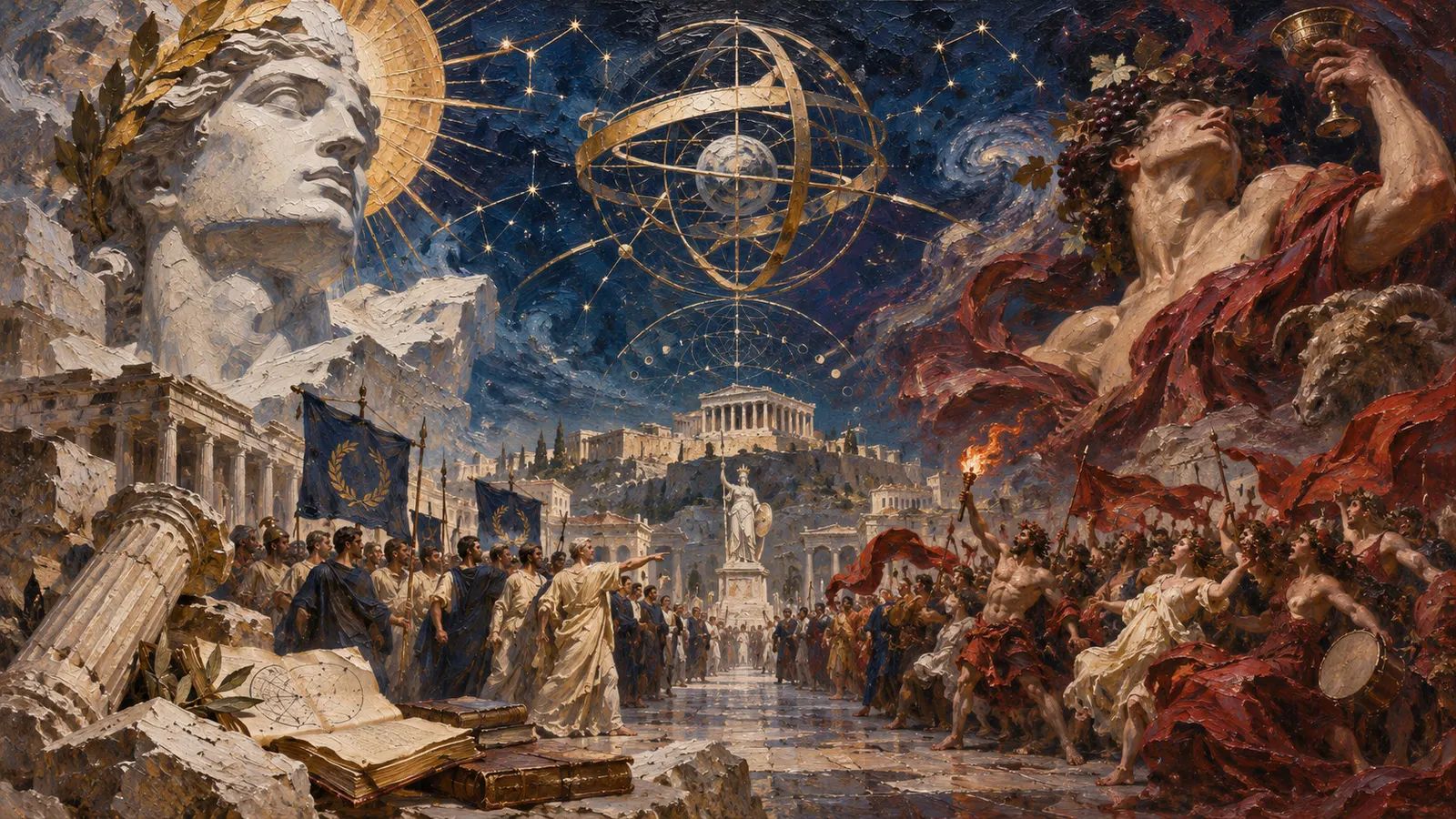
From Temperaments to Antagonisms: How Conflict Becomes a Problem of the World Bringing James, Neyrat and Benjamin into relation thus resolves nothing through the mere addition of perspectives. Rather, it makes a detour through Nietzsche necessary. In Beyond Good and Evil , Nietzsche suggests that the great philosophies bear, to some degree, the imprint of their authors’ involuntary confessions. His proposition does not authorize us to replace the examination of arguments with a psychological assessment of those who produce them. It shifts the question towards the values that make certain images of the world desirable, the drives that invest the categories of order, and the claim of those categories to free themselves from the conditions of their genesis. Conflict, then, is neither immediately a logical contradiction nor merely a clash of individual sensibilities: it also runs through the historical formation of the criteria by which certain things appear worthy of being known or saved. [11]
An Eye on the Event
Author portrait
By Hisham Dibsi - Published Nov 22, 2026 - 03:49
News feature image
(Photo by Sergei BOBYLYOV / POOL / AFP)
My recent visit to China was not merely an opportunity to discover a country undergoing enormous economic, urban and technological transformations. It also allowed me to observe some of the smaller details of everyday life and to try to understand the social culture and vision of the future underlying these transformations. At one point during my visit, I went to a panda park, where I witnessed the birth of panda triplets and observed the public interest generated by the event, as well as the way visitors responded to it. I was struck by the orderly way people moved around, their respect for the surroundings and nature, and their concern not to disrupt the order of the protected park. These were simple scenes, yet they revealed something about society’s relationship with public space and the organisation that makes collective life more harmonious.
Analyze
Author portrait
By Yakzan Takki - Published Nov 21, 2026 - 15:28
News feature image
In Toronto, Canada, Iranian scientist Kaveh Madani, born in Tehran in 1981, heads the United Nations University Institute for Water, Environment and Health, which coordinates research on water resources and makes policy recommendations. In 2026, he received the Stockholm Water Prize, widely regarded as the “Nobel Prize of Water,” notably for his work on the concept of “water bankruptcy,” at a time when the world is depleting its water resources faster than they can be replenished. Madani is seeking to use his position to make his voice heard within the Iranian diaspora, particularly during the war waged by the United States and Israel against Iran. He regularly speaks out on social media, where he has thousands of followers. He denounces abuses committed by the Tehran regime and draws attention to the environmental damage caused by the war in which his country is involved, including the toxic rainfall that followed missile strikes on oil depots in Tehran.
More Articles
Sort By: NewestOldest
Sharjah, pioneer of culture in the Emirates
By
Micha Moussallem
Published

For several decades, Sharjah has distinguished itself as the cultural capital of the Arab world, a title officially bestowed by UNESCO in 1998 in recognition of the emirate’s commitment to art, culture, and education, as well as its cultural landscape. Under the guidance of Sheikh Sultan bin Mohammed Al Qasimi, who has ruled the emirate since 1972, Sharjah has developed a unique artistic ecosystem in the Middle East, establishing itself as an essential destination for art lovers and cultural professionals alike. The modern history of art in Sharjah is closely tied to the founding of the Sharjah Art Foundation in 2009, under the leadership of Sheikha Hoor Al Qasimi. This multidisciplinary institution supports both local and regional artistic creations while fostering connections with international artists. The foundation regularly stages major exhibitions, organizes workshops in collaboration with partners, and offers research grants and mentorship programs aimed at empowering young artists, women, and innovative creators.

“The Iranian Empire”: Iraq, an Open Wound; Gaza, Palestinian Strategic Depth (4/5)

For a long time, Iraq was the keystone of the Islamic Republic of Iran’s geostrategic maneuvers and ambitions. Without Iraq, nothing holds together: neither the land corridor to Syria, nor the sanctions-busting economy, nor the network of militias that provided Iran with strategic depth in the Gulf. Powerful Shiite militias (the PMF), financed, trained, and supervised by the Revolutionary Guards, controlled for years the border areas of al-Qaim/Bukamal, through which weapons, fighters, and technologies transited toward Syria and Lebanon. The Iraqi government, wavering, constantly oscillated between Washington and Tehran, yet Iranian leverage remained massive. Today, Iraq has become a field of contradictions: U.S. pressure is increasing to sanction pro-Iranian networks; militias have been weakened by the disorganization of the Syrian front; the recent internal dispute over the classification of Hezbollah and the Houthis—placed on and then removed from terrorist lists within a few days—clearly reveals confusion; and, last but not least, an Iraqi nationalism is taking shape that rejects Iranian interference as much as American dominance.

Please Forget
By
Jawad Pakradouni
Published

For many, forgetting is a coping mechanism that helps them overcome hardship. But it is also the means—and often the goal—sought by wrongdoers eager to erase their tracks. A population with the memory of a goldfish is every fisherman’s dream: a form of collective Alzheimer’s that guarantees a quiet life, smooth and undisturbed. Lebanon is perhaps the most striking example. Recently, some financial institutions have begun offering interest-bearing returns on cash deposits—an expression we had not heard since 2019. For many, this is worse than the apple in the Garden of Eden: Adam and Eve were naked before taking a bite, whereas we succumbed to these usurious interest rates, which led us straight into erosion and ruin.

In Riyadh, Art Everywhere and for Everyone
By
Micha Moussallem
Published

The entire Gulf region, and especially Saudi Arabia, is currently experiencing major social and economic transformations. These countries, whose economy once relied solely on oil production, are rapidly opening up to new technologies, AI, global sporting events, and most importantly, art and culture. From Jax, the cultural district of Riyadh, to the AlUla Oasis, Saudi Arabia—the largest country in the Middle East—is investing huge sums to promote art and culture. For the Saudi government, in a society undergoing profound changes, art helps preserve the country’s cultural heritage, transmit traditions and ancestral know-how, while opening the door to cutting-edge artistic projects. Among these ambitious projects, Riyadh Art holds a special place. Launched in 2019 by King Salman bin Abdulaziz Al Saud, it is part of Vision 2030, the grand development plan of Crown Prince Mohammed bin Salman.

“The Iranian Empire”: The Land Corridor and the Ambition of the Levantine Empire

Iran's strategy is not solely maritime. It has been built, with almost Roman patience, around a land arc : Tehran – Baghdad – Damascus – Beirut. For twenty years, Tehran patiently constructed a “Shiite crescent” connecting Iran to the Mediterranean, under the control of the vilayet e-faqih , the Iranian spiritual guide. Thus, it has sanctified Shiite militias and taken control of border areas in Iraq; it gained decision-making ascendancy from 2012 in its partnership with the Assad regime, with the intervention of the Pasdaran and Hezbollah to protect the Assad regime (later shared with Moscow during the Russian intervention from September 2015; and, above all, with the peak, from 2008, of Hezbollah in Lebanon as an expeditionary force and strategic projection tool).

Like leaven in the dough…
By
Fady Noun
Published

The vocation of the Church, of every Church and of all Churches, is charted by Christ. This vocation is both to be universal and inclusive with the aim of banishing all discrimination. It is to be the leaven in the dough and/or the salt without which all food loses its flavor and becomes inedible. In other words, as salt is made for food, we are not made for ourselves, we are 'beings for others.' This vocation is also to proclaim, through our words and our actions, the 'good news' of Christ. 'The foundational base of a minimal national history' and the beginning of the crystallization of a national identity, observed by historian Candice Raymond, is what we have most precious to offer our compatriots – and we must speak of it indistinctly as Maronites and as Lebanese. This foundation is our pride: it is the beginning of a stable and defined identity that we must protect from anything that could disfigure it.