
Levant Time logo

Articles

News feature image
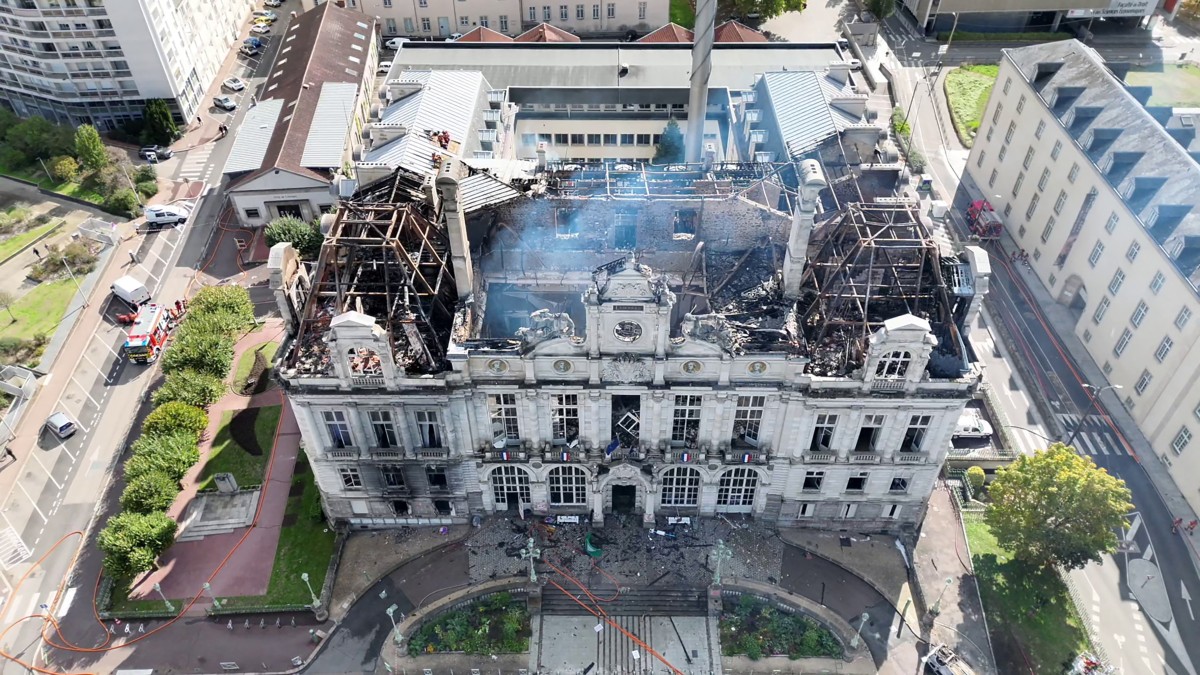
Built in the 19th century, Limoges City Hall is listed as a historic monument. It was largely destroyed in an arson attack by radicalized and violent rioters, according to the authorities. (AFP)
Today's Essential
Author portrait
By LevantTime .
Published Oct 20, 2026 - 00:51
The French government announced its first measures on Monday in response to the weekend riots in several cities across the country, starting with “partial” and “localized” curfews, even as the possibility of declaring a state of emergency was raised. President Emmanuel Macron, who is touring the Gulf states, reportedly preferred not to declare a state of emergency to avoid spooking the markets, especially since Paris had very recently announced an increase in its debt and public deficit. Political or security instability would certainly affect interest rates. The “chaos” is “confined to very specific urban areas,” Prime Minister Sébastien Lecornu said. He said he had “asked prefects to impose a number of curfews tonight,” Monday, specifying that they would be “localized” and “partial.”
Economy
Author portrait
By Bernard Raymond Jabre - Published Oct 19, 2026 - 19:26
News feature image
The Peterson Foundation’s famous US national debt clock in Atlanta displays the astronomical figure of $40 trillion on September 8, 2026. (Derek White / Getty Images via AFP)
Debt is taking the blame. We watch trillions pile up in the United States, France, Italy and elsewhere in Europe, and wonder how far it can go. But debt is not the disease. It is the symptom. The disease is a budget deficit that has become permanent. We need to go back to Keynes. John Maynard Keynes never envisioned deficits as a normal, permanent feature of government. His thinking was rooted above all in the economic cycle. When the economy collapses, private investment dries up, unemployment rises, and fear paralyzes businesses and households, the state must step in. It spends, invests and accepts a temporary deficit. Monetary policy can also become more accommodative.
Opinion
Author portrait
By Nawaf Kabbara - Published Oct 19, 2026 - 11:17
News feature image
Marco Rubio’s recent speech in Athens, calling for the renewal of Western civilization and the restoration of its political, economic, and military strength, raises a fundamental question: Are we witnessing a temporary crisis of Western leadership, or have we reached the historical limits of the political and social order upon which Western dominance was constructed? I would argue that we are witnessing several interconnected crises: the limitations of Western democracy, the transformation of historically dominant identities, the declining capacity of the nation-state to address global challenges, and the inadequacy of security policies based primarily on military power.
More Articles
Sort By: NewestOldest
In Nicaea, the Pope Preaches the Creed of Christian Unity

The city of Iznik, ancient Nicaea, marked a key stop on Pope Leo XIV’s visit to Turkey, as the pontiff led a service dedicated to Christian unity on the shores of Lake Iznik, south of Istanbul. The ceremony brought together Orthodox and Protestant leaders for a prayer service among the ruins of a submerged 4th-century basilica. The Mass commemorated the 1,700th anniversary of the First Ecumenical Council of Nicaea, convened in 325, twelve years after the Roman Empire legalized Christianity. Standing beside Patriarch Bartholomew I of Constantinople and other church leaders, Pope Leo XIV recited the Nicene Creed — a statement of faith still recited by millions of Christians worldwide. The creed was first adopted at the very council that gathered in Nicaea almost 17 centuries ago.

From Leo XIII to Leo XIV (Open Letter)
By
Amine Jules Iskandar
Published

By treating borders and constitutions as sacred and untouchable, today’s Lebanese politics forget that these tools exist for one purpose: the well-being of the human person — the one Your Holiness came to listen to in their suffering. Most Holy Father, During your visit to Lebanon, a grand national scene will be prepared to show prosperity and joy, where the splendor of religious sites will outshine that of state institutions. But has Your Holiness come to see the life of palaces, or the life of a people worn down by fifty years of conflict, poverty and exodus, with no light on the horizon? Allow us, Holy Father, to share words that you will not hear in official halls. Lebanon is exhausted. No society can survive endless wars and crises by treating only the symptoms without ever diagnosing the cause. There is, undoubtedly, corruption at the national level, and the expansionist ambitions of our neighbors at the regional level. But there is also a structural problem rooted in the very formation of our state.

The Levant in Turmoil: An Elusive Peace (1/3)
By
Jean-Patrick Dayras
Published

The Levant unmistakably reached a crucial tipping point on 7 October 2023, as Hamas launched a deadly attack on Israeli territory from the Gaza Strip. The circumstances and repercussions of this swift and bloody offensive sent a seismic shock through Gaza and Israel, of course, but also across other key centers of the Levant, notably Lebanon and Syria, and, by extension, Iran and Yemen. The devastating impact of Hamas’s attack on Gaza and its population has once again brought the entire Israeli-Palestinian conflict to the forefront. Some had hoped that the events of 7 October 2023 might lead to a breakthrough in the longstanding Middle Eastern conflict, which has blighted the region for over seven decades. At this stage, this is far from being the case, at least in appearance. It is particularly regrettable that the Palestinian Authority has been unable to regain the initiative and embark on a swift and promising dialogue with Israel.

Baptized a “message-country,” Lebanon awaits the communion of peace

Pope Leo XIV has chosen Lebanon – baptized by his predecessor, Saint John Paul II, as a “message-country” – for his first apostolic trip outside Italy. Under the theme “Blessed are the peacemakers,” the visit pierces through Lebanon’s war-scarred history like a ray of light. “Blessed are the peacemakers”: four words that set the tone. They leave their mark on the unfolding events and the course of history itself, as well as on the schedule of the visit, which is packed with official and ecumenical meetings, culminating in the solemn Mass to be celebrated along Beirut’s seafront. Yet, one must ask: does Lebanon truly need a communion of peace?

Leon XIV and the Lebanese Exception
By
Youssef Mouawad
Published

What a source of concern—and even of irritation—for Roman authorities, these Eastern Catholics do indeed generate! Had they vanished from the Levant, diplomatic relations between Rome and the Muslim countries of the Eastern Mediterranean would have been far smoother. That being said , things were never simple for Vatican diplomacy, on dealing deal with the Maronite community. Very early on, the Maronites asserted themselves politically as an autonomous entity rooted in a mountain stronghold, and what is more they never hesitated in insisting upon their distinctiveness. This set them apart from the other Christian communities of Syria and Iraq, which had long submitted to the rule of the majority and produced, for the most part, quiet individuals and compliant citizens.

The Pope in Lebanon: Without Peace, the “Message-Country” Will Not Survive

Pope Leo XIV is set to bring a powerful message to Lebanon: “Blessed are the peacemakers.” A unifying call, with deep religious resonance, that resonate cross its religious communities, while carrying a clear political weight for a country exhausted by decades of conflict – a nation for whom the time has come to leave the tunnels of violence behind and step into the light of peace. Firstly: Supporting the Christian Presence and Affirming Its National Role This message stems from the Holy See’s careful attention to what Lebanon has endured – and continues to endure – particularly its Christian population. For the Vatican, Lebanon is the most sensitive “laboratory” in the Middle East for Muslim–Christian coexistence, and a potential model of what John Paul II, three decades ago, described as a “message-country.”

/