
Levant Time logo

Articles

News feature image
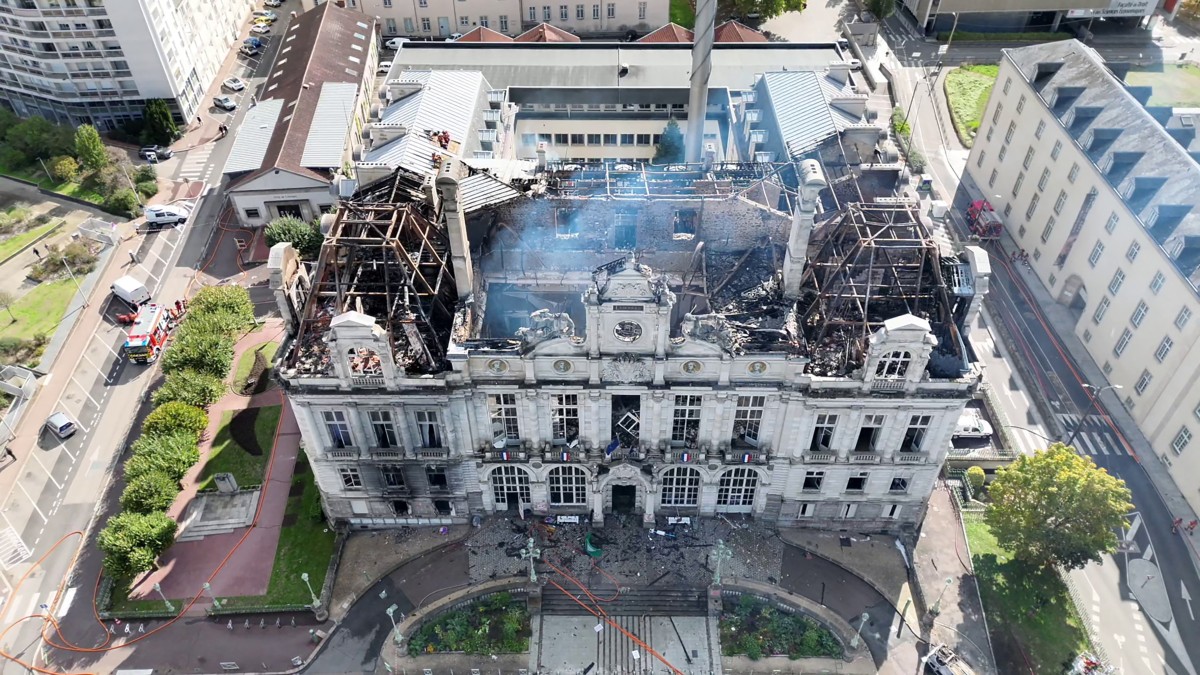
Built in the 19th century, Limoges City Hall is listed as a historic monument. It was largely destroyed in an arson attack by radicalized and violent rioters, according to the authorities. (AFP)
Today's Essential
Author portrait
By LevantTime .
Published Oct 20, 2026 - 00:51
The French government announced its first measures on Monday in response to the weekend riots in several cities across the country, starting with “partial” and “localized” curfews, even as the possibility of declaring a state of emergency was raised. President Emmanuel Macron, who is touring the Gulf states, reportedly preferred not to declare a state of emergency to avoid spooking the markets, especially since Paris had very recently announced an increase in its debt and public deficit. Political or security instability would certainly affect interest rates. The “chaos” is “confined to very specific urban areas,” Prime Minister Sébastien Lecornu said. He said he had “asked prefects to impose a number of curfews tonight,” Monday, specifying that they would be “localized” and “partial.”
Economy
Author portrait
By Bernard Raymond Jabre - Published Oct 19, 2026 - 19:26
News feature image
The Peterson Foundation’s famous US national debt clock in Atlanta displays the astronomical figure of $40 trillion on September 8, 2026. (Derek White / Getty Images via AFP)
Debt is taking the blame. We watch trillions pile up in the United States, France, Italy and elsewhere in Europe, and wonder how far it can go. But debt is not the disease. It is the symptom. The disease is a budget deficit that has become permanent. We need to go back to Keynes. John Maynard Keynes never envisioned deficits as a normal, permanent feature of government. His thinking was rooted above all in the economic cycle. When the economy collapses, private investment dries up, unemployment rises, and fear paralyzes businesses and households, the state must step in. It spends, invests and accepts a temporary deficit. Monetary policy can also become more accommodative.
Opinion
Author portrait
By Nawaf Kabbara - Published Oct 19, 2026 - 11:17
News feature image
Marco Rubio’s recent speech in Athens, calling for the renewal of Western civilization and the restoration of its political, economic, and military strength, raises a fundamental question: Are we witnessing a temporary crisis of Western leadership, or have we reached the historical limits of the political and social order upon which Western dominance was constructed? I would argue that we are witnessing several interconnected crises: the limitations of Western democracy, the transformation of historically dominant identities, the declining capacity of the nation-state to address global challenges, and the inadequacy of security policies based primarily on military power.
More Articles
Sort By: NewestOldest
Lebanon, a land of encounter, a land of Christian unity

“Thank you for coming” is probably one of the phrases Leo XIV heard most often during his stay in Lebanon. For many, the popular welcome given to the Pope came as a surprise. Leo XIV praised the “simplicity” of our faith. He must have rediscovered in Lebanon something of the faith of the peasants of Peru, that of a people untouched by the intellectual sophistication of the West. “Wow! Thank you to Peru, and especially to Chiclayo, for having so beautifully shaped this man of God, so full of zeal and compassion,” wrote a retired engineer on Facebook who spent three days glued to the television. Mother Marie Makhlouf, the superior of the Sisters of the Cross, and the two women who received the comfort of his embrace, in Bkerké and at the port, would certainly agree. Now, Pope Leo XIV knows Lebanon intimately, and the people saw the joy of the encounter on their faces.

A Policy of Denial and Collective Suicide
By
Jawad Pakradouni
Published

In the French baccalaureate history textbook, there's a chapter on page 138 entitled "The Birth of the State of Israel." However, strangely enough, it jumps from page 137 to page 140, with the two pages of the aforementioned chapter stuck together. This way, our children will be spared learning about the creation of a country that our own refuses to recognize, and therefore doesn't officially exist… Imagine the results on the baccalaureate exam if this topic is ever asked. Meanwhile, the army of this non-existent country is decimating everything in its path or during its overflights. One might conclude that we are being attacked by ghosts or spirits. We don't need regular forces or so-called paramilitary "resistance," but an exorcist.

Syria, Between Challenges and Opportunities: A New Beginning (1/4)

On December 8, 2024, the regime of Bashar al-Assad fell in Syria. After more than fifty years of bloody dictatorship and thirteen years of civil war that left more than 600,000 dead and displaced more than a quarter of the population, a new wind is blowing across Syria, bringing with it a wave of optimism. As in every country left in ruins after a civil war, in Syria, everything needs to be rebuilt. Thanks to its geographical location, its wealth of natural resources, and the support of the Gulf states, the new Syria of Ahmad el-Sharaa presents numerous opportunities. But at the same time, the country must face many challenges, particularly in terms of security and socio-political stability.

Lifting of Sanctions on Syria: early Signs of the Country’s Reconstruction

On November 6 th , the United Nations Security Council, driven by the United States, voted to lift UN sanctions against Syrian President Ahmad el-Chareh. This measure followed a similar decision earlier in the summer, when both the United States and the European Union ended their sanctions against Bashar el Assad’s Syria, which had been imposed during the civil war that began in 2011. The general lifting of sanctions will allow Syria to reintegrate into the Arab sphere and the global economy, paving the way for renewed investment and the reconstruction of the country. The Caesar Act The most emblematic measure among the sanctions targeting Assad’s Syria was the adoption of the Caesar Act by the United States in 2019. The law was named after a Syrian military photographer who smuggled out more than 50,000 photographs documenting abuses committed by the Baathist regime during the civil war.

Pope Leo XIV: The Land of the Cedar Has Adopted You…!

Your Holiness, You kindly chose this country of the Levant as your first destination after your election as head of the Catholic Church. We thank you for that! Your presence here resembled the shadow of a white cloud gliding through a dark sky that has been overcast for far too long, letting its light shine upon this geographical space described in history books as the land of milk and honey, the land of hospitality and conviviality, the land of the eternal Cedar—majestic, strong, and unwavering. A land of encounter and exchange among cultures and diverse communities; a land of life, love, and peace, regularly attacked and often violated.

The Abrahamic Family House, for a world of tolerance and peace

In 2019, Pope Francis was the first pope to make an official visit to Abou Dhabi. During this visit, Pope Francis and the Grand Imam of Al Azhar, Dr. Ahmed Al Tayeb, made history by jointly signing a document on human fraternity calling for tolerance, universal peace, and reconciliation between all religions. To commemorate this historical visit and in line with the charter of human fraternity, the government of the United Arab Emirates decided to build on Saadiyat Island the Abrahamic Family House, an architectural space of nearly 6,000 square meters dedicated to the three monotheistic religions. Inaugurated in 2023, it includes a church, a mosque, and a synagogue, as well as a forum.