
Levant Time logo

Articles

News feature image
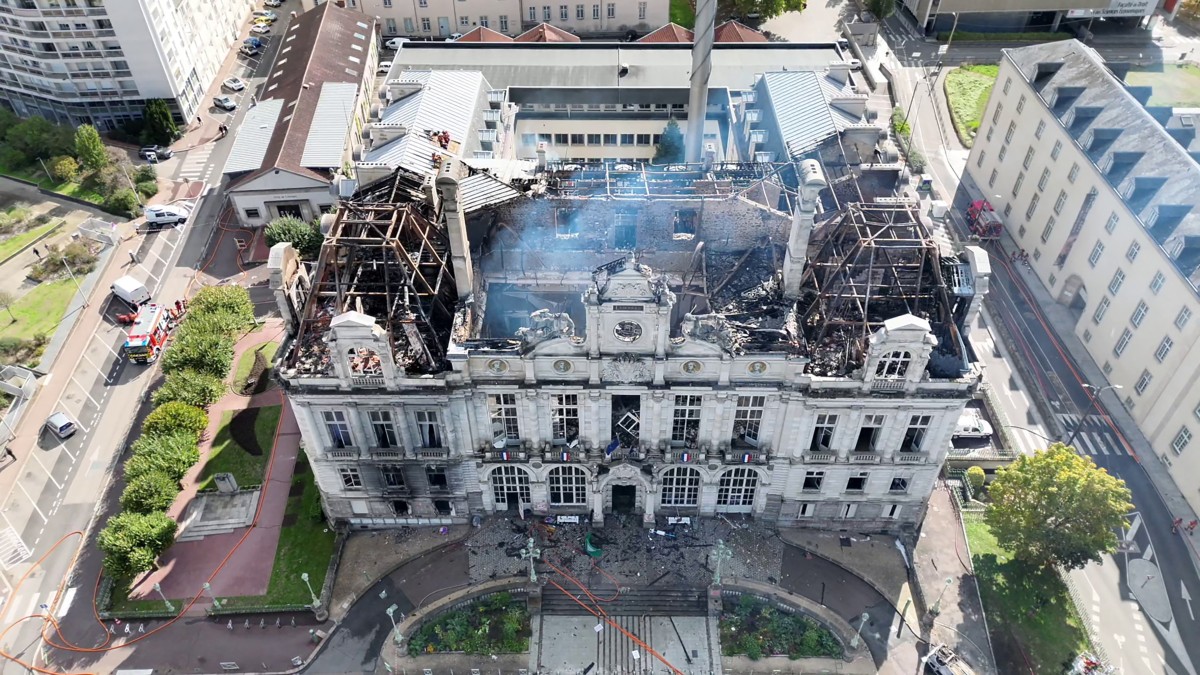
Built in the 19th century, Limoges City Hall is listed as a historic monument. It was largely destroyed in an arson attack by radicalized and violent rioters, according to the authorities. (AFP)
Today's Essential
Author portrait
By LevantTime .
Published Oct 20, 2026 - 00:51
The French government announced its first measures on Monday in response to the weekend riots in several cities across the country, starting with “partial” and “localized” curfews, even as the possibility of declaring a state of emergency was raised. President Emmanuel Macron, who is touring the Gulf states, reportedly preferred not to declare a state of emergency to avoid spooking the markets, especially since Paris had very recently announced an increase in its debt and public deficit. Political or security instability would certainly affect interest rates. The “chaos” is “confined to very specific urban areas,” Prime Minister Sébastien Lecornu said. He said he had “asked prefects to impose a number of curfews tonight,” Monday, specifying that they would be “localized” and “partial.”
Economy
Author portrait
By Bernard Raymond Jabre - Published Oct 19, 2026 - 19:26
News feature image
The Peterson Foundation’s famous US national debt clock in Atlanta displays the astronomical figure of $40 trillion on September 8, 2026. (Derek White / Getty Images via AFP)
Debt is taking the blame. We watch trillions pile up in the United States, France, Italy and elsewhere in Europe, and wonder how far it can go. But debt is not the disease. It is the symptom. The disease is a budget deficit that has become permanent. We need to go back to Keynes. John Maynard Keynes never envisioned deficits as a normal, permanent feature of government. His thinking was rooted above all in the economic cycle. When the economy collapses, private investment dries up, unemployment rises, and fear paralyzes businesses and households, the state must step in. It spends, invests and accepts a temporary deficit. Monetary policy can also become more accommodative.
Opinion
Author portrait
By Nawaf Kabbara - Published Oct 19, 2026 - 11:17
News feature image
Marco Rubio’s recent speech in Athens, calling for the renewal of Western civilization and the restoration of its political, economic, and military strength, raises a fundamental question: Are we witnessing a temporary crisis of Western leadership, or have we reached the historical limits of the political and social order upon which Western dominance was constructed? I would argue that we are witnessing several interconnected crises: the limitations of Western democracy, the transformation of historically dominant identities, the declining capacity of the nation-state to address global challenges, and the inadequacy of security policies based primarily on military power.
More Articles
Sort By: NewestOldest
Nostra Aetate, cornerstone of interreligious dialogue – The Roots (1)

The Vatican and the global Catholic community, including Lebanon, are currently marking the 60th anniversary of Nostra Aetate , the declaration promulgated by Pope Paul VI on the Catholic Church’s relationship with non-Christian religions. In Lebanon, a conference was held in Bkerké on November 8 to commemorate the event. The statement has often been called prophetic , and rightly so. It was written at a moment when, despite growing contact between peoples through modern transport and communication, religion was increasingly being used as a tool of violence across the five continents. The culture of religious and racial hatred had reached its darkest point in Europe during World War II, with the Holocaust and the extermination of millions of Jews by the Nazis.

A message to the entire Levant
By
Riccardo Cristiano
Published

Pope Leo gave the Lebanese what belongs to the Lebanese: recognition of their great resilience. But if we try to read his words on the serious global problem he identified for everyone through Lebanese eyes—let's say Lebanese eyes only, since he addressed these words to the whole world—we would understand that this resilience should be investigated: “A kind of pessimism and sense of powerlessness seem to have taken hold, where people are no longer able to ask themselves what they can do to change the course of history. Major decisions appear to be taken by a select few, often to the detriment of the common good, as if this were an inevitable destiny”.

What Is Integral Ecology, According to Pope Francis?

As Pope Leo XIV visits Lebanon — and with the 30th UN Climate Change Conference in Belém, Brazil, ending with few tangible results — it is worth revisiting the concept of « Integral Ecology », a central idea in Pope Francis’s 2015 encyclical « Laudato Si’ ». The document outlines a deeply human and inclusive vision of ecology — one that calls for both spiritual renewal and social justice. The term integral ecology reflects a holistic approach to the relationship between humankind and the environment. It promotes a worldview where environmental, social, cultural, and spiritual dimensions are inseparable. As the French Catholic Church site explains, this concept rests on “the conviction that ecological conversion is not confined to environmental issues alone” but also draws on hope, respect for all life, and a commitment to human dignity and fraternity. The Church, in this view, bears a moral responsibility for the care of Creation.

The "Gathering of Lebanese Shia" to the Pope: in favor of the State’s monopoly on weapons

The “Gathering of Lebanese Shia” sent a message to Pope Leo XIV stating that the Lebanese State’s exclusive control of weapons “is the essential foundation for building a strong and just State.” Supporting peace “in accordance with Arab initiatives and international legitimacy,” the Gathering stressed its commitment to “acting exclusively under the authority of the State and the rule of law, and to supporting everything that strengthens its presence.” The “Gathering of Lebanese Shia” brings together academics, journalists, senior professionals, and Shiite citizens known for their sovereigntist stance, fundamentally opposed to Hezbollah’s political project.

Miscount in Toynbee’s Prediction
By
Nabil Manuel Younes
Published

In 1957, the historian and philosopher of history Arnold Toynbee delivered a lecture at the Cénacle Libanais entitled « Le Liban, expression de l’Histoire ». After exploring the complexity of Lebanese history and its interactions with surrounding civilisations, and after analysing how Lebanon—owing to its geographic position and its multi-confessional composition —has long served as a meeting point as well as a battleground for competing religions and identities, Toynbee concluded his talk with a remarkably prescient warning. He said: If, in the Levant, the frontier between the two global empires—American and Russian—were to be drawn along the crest of Mount Anti-Lebanon, the Lebanese Republic would risk sharing the fate of the State of Israel. Like Israel, Lebanon would not be viable if it were to find itself in a permanent state of hostility with its neighbors to the East.

Del Toro: Exorcising the Man from His Monster
By
Michel Hajji Georgiou
Published

Is it true that a filmmaker essentially explores a single theme—or a single universe—through the whole of their work, in the sense that everything ultimately forms a coherent whole, as Jean-Luc Godard suggested? Guillermo del Toro seems to fit this theory perfectly. The Mexican director, who has just delivered (on Netflix) his own version of one of cinema's most exploited figures—Mary Shelley's Frankenstein —appears driven by a foundational, almost obsessive, even prophetic intuition that is indeed detectable throughout his entire body of work and gives him a rare coherence. For del Toro, the monster is never the monster. Deformed otherness, scarred flesh, unnatural anatomy are never synonymous with actual monstrosity in his work. Quite the opposite: in the Mexican director's vision, the monster is the most human figure of all—one bearing the weight of suffering, loneliness, rejection, humiliation, but also love. Admittedly, he is far from the first to venture onto this terrain. But in an increasingly dehumanized world, his project rings with an even more striking truth.