Levant Time logo

Articles

News feature image
Massive explosion caused by an Israeli strike near the town of Al-Mansouri in southern Lebanon. (AFP)
Weekly essentials
Author portrait
By LevantTime .
Published Sep 6, 2026 - 23:27
While the United States had appeared to be relying solely on economic warfare against Iran, the US military abruptly carried out strikes on Iranian territory on Tuesday in retaliation for attacks targeting oil tankers, setting off a spiral of violence over the course of the week. In Lebanon, Israel released several civilians held in its prisons, while its army seized the strategic Ali el-Taher hill and continued its heavy strikes in the area it controls in the south of the country. The week from August 31 to September 6 was marked by a sharp acceleration of events in the Middle East, after the previous one had seemed defined by relative stagnation. On the Iranian front, the US military carried out targeted strikes inside Iranian territory as early as Tuesday evening, the first in nearly a month. This screen grab, made on September 6, 2026 from undated video footage released the same day by US Central Command, shows what CENTCOM says is one of the Iranian oil tankers it destroyed in response to attempted missile attacks on naval vessels. (CENTCOM via AFP) However, the relatively limited pace of the strikes suggests that the US administration has opted for an escalation that remains controlled, while continuing its blockade and economic pressure on Tehran. Even so, tensions continued to rise throughout the week. Explosions were heard on Saturday on the highly strategic island of Kharg, through which most of Iran’s oil exports pass. US President Donald Trump, for his part, threatened to strike the Kuh-e Kolang nuclear site — “Pickaxe Mountain” in Persian — a heavily fortified facility located deep underground, not far from Natanz, Iran’s main uranium-enrichment site. Earlier in the week, he had enshrined the “tanker for tanker” equation, pledging to target an Iranian vessel every time the Islamic Revolutionary Guard Corps struck an oil tanker in the Strait of Hormuz. That is precisely what the US military did on Saturday, setting two Iranian vessels ablaze. Politically, Donald Trump further hardened his tone toward Tehran. After saying in an interview that talks had been permanently frozen “because an agreement with them is not worth the paper it is written on,” he said on Saturday that the “conflict” with Iran was not a “war,” but “something ordinary” for the United States. A way of rattling the Iranians while at the same time reassuring the US public ahead of the midterm elections. A port, along with storage facilities and warehouses, was damaged following a US military strike carried out on September 6, 2026 in Iran’s southern Hormozgan province, which borders the Strait of Hormuz. (AFP) At the same time, the US news outlet Axios published a report on Saturday suggesting that the United States is already looking beyond this conflict, which began on February 28. Citing US officials and other informed sources, the outlet said the Trump administration is developing a broader strategy for the post-war Middle East. According to the report, it would be based on creating a regional alignment aimed at containing Iran, bringing an end to the regional fallout from Hamas’s October 7, 2023 attacks in Gaza, and expanding the circle of normalization between Israel and countries in the region. The threat against Kuh-e Kolang, which brings the Iranian nuclear issue back to the fore, echoes an announcement by the International Atomic Energy Agency (IAEA), which said on September 1 that Iran had still not reopened its sites to inspectors following the strikes of May 2025. It should be recalled that despite the scale of the Israeli-American offensive against Iranian sites, it is almost certain that the stockpile of enriched uranium remains intact and has been moved to a safe location by the Iranian authorities, which remain committed to what they consider their right to develop a nuclear program. Following the IAEA announcement, the United States, together with France, Britain and Germany, said they intended to submit a resolution to the UN Security Council condemning Iran’s failure to comply with its non-proliferation commitments. This display of unity stands in contrast to the chill that has prevailed between Washington and its European allies since the beginning of the conflict. For their part, the Iranians appear to be responding to the upheaval in much the same way as before: by striking neighboring countries, notably Kuwait, the United Arab Emirates and Jordan, without directly targeting Israel. Heavy strikes in southern Lebanon On the Lebanese front, Israel is intensifying its destruction operations in villages in the south, even using explosive barrels in some cases. Lebanese President Joseph Aoun urged Washington and the international community to “put an end” to Israeli attacks on Lebanese territory, which killed seven people on Sunday against the backdrop of a fragile truce. The strikes hit several localities in the Nabatiyeh region. Twenty people were also wounded, including children, according to the Health Ministry. One strike also destroyed the former Ghandour hospital, which had been out of service for years. Release of detainees and capture of Ali el-Taher But the major event of the week in the south was the Israeli capture of the strategic Ali el-Taher hill in the Nabatiyeh region. The site served as a major Hezbollah headquarters, consisting of an extensive network of tunnels from which fighters from the Shiite party operated, along with, according to some reports, Iranian fighters. On Thursday evening, the Israelis announced that they had taken control of the complex. On Sunday, Israeli Defense Minister Israel Katz said that tunnels still had to be blown up. This military “success” may not have come as a surprise after weeks of bombardment, but Hezbollah’s reaction was more unexpected. After long insisting that it would refuse to give up this strategic hill — as had the Iranians, who had also threatened to intervene — the Shiite party ultimately sought to play down the significance of the development through its media outlets and allied networks, without officially confirming the loss of the site, which it had refused to preserve by handing it over to the Lebanese army. The other major surprise of the week was Israel’s release of five Lebanese and Syrian civilians held in its prisons. The move came following a visit to Tel Aviv by US Ambassador to Lebanon Michel Issa. According to the Israeli prime minister’s office, Thursday’s announcement “follows efforts by Israel and Lebanon to locate and repatriate the remains of leaders of the Jewish community who had been abducted and killed in Lebanon” between 1984 and 1986. Here too, Hezbollah’s reaction raises questions. While describing the move as positive but insufficient, the party once again turned on the Lebanese authorities, accusing them of “submission to the enemy” and holding them “responsible” for the disaster in the south. It even warned them against “internal conflicts.” Could the party’s military setbacks push it to turn increasingly toward the domestic front? Finally, the Israeli army made an important statement on Sunday, saying it was considering reducing its occupation zone in southern Lebanon, moving from the current “yellow zone” to a “grey zone.” Such a development would, according to this assessment, reflect a reduced threat from Hezbollah. The measure has not yet been approved by Israel’s political leadership. Yemen and Palestine The week was also particularly tense in Yemen, where clashes between Houthi rebels and government forces continued to intensify, culminating in an especially deadly Saturday in which more than 60 people were killed in a single day, bringing the death toll since Thursday to around 200. The Houthi offensive is aimed in particular at taking control of areas bordering the Bab el-Mandeb passage, which would give this Iranian ally additional leverage over another major strategic chokepoint after the Strait of Hormuz. In Palestine, particularly troubling comments by Israel Katz on Gaza marked the week. He claimed, without providing evidence, that most of the territory’s residents wanted to leave, stressing that Israel was “ready for such an evacuation” on a mass scale. A sign that the ordeal of Gaza’s residents may be far from over. Finally, it is worth noting that the IAEA announced on September 1 that facilities discovered in Deir el-Zor, Syria, indicate that Bashar al-Assad’s former regime had secretly been preparing an advanced nuclear program that could have led to the production of an atomic weapon with the help of North Korean experts.
Homage
Author portrait
By Michel Hajji Georgiou - Published Sep 6, 2026 - 13:31
News feature image
The Argentine player, who brought his international career to an end on August 31, 2026, was nothing less than a magician of the stadiums. His journey, made of wonders, falls and redemption, may tell us something about our undiminished need for enchantment in a world that nevertheless claims to have rid itself of it. Announced a few weeks after the 2026 World Cup final lost to Spain, Lionel Messi’s international retirement inevitably stirred an emotion for which it is difficult to find many equivalents in the recent history of football. One would probably have to go back to Maradona, or perhaps to Cruyff or Pelé, to recover that sense that, with the retirement of a player, something disappears that extends far beyond the sport itself, as though a certain way of inhabiting football, perhaps even of believing in it, were also coming to an end. Far from the glacis of reason Enough of the endless statistics and the unbearable, tedious and sterile quarrels over “who is the greatest of all time.” The author of these lines has never been a fanatic of the round ball, nor, for that matter, of vertical rankings or hierarchies of merit in general, and consequently appreciates the talent of each player with the same sense of wonder as an eleven-year-old child. Besides, this particularly contemporary obsession with numbers ruins all the pleasure of the spectacle. And with good reason: the approach that consists in adding up goals, assists, Ballons d’Or, Champions Leagues, Copa América titles, World Cups… can only be reductive. On another register, it is not entirely unrelated to German-American philosopher Eric Voegelin’s critique of the modern Gnostic temptation: that of a form of knowledge convinced that it can imprison reality within a system and abolish whatever resists it. Records are probably one indicator of Lionel Messi’s genius. Yet so many other great players who made stadiums and hearts tremble, without achieving half of what he did, nevertheless remain eternal in our memories. What made them truly singular lies elsewhere, far from the glacis of reason. Something else was at work around them. Something belonging to a certain profound sense of transcendence that understanding can never fully grasp. This has been true of Lionel Messi for more than twenty years, since the day when, under the gaze of the “icon” Diego Maradona, he made his first appearance, in June 2006, on the World Cup stage in the colors of the Albiceleste against Serbia and Montenegro. That ineffable element that constitutes Messi’s genius, as it does that of others, may indeed touch upon one of modernity’s strangest paradoxes: the persistence of magic in a world that has constructed itself precisely against it. The disenchanted world Max Weber used the expression “disenchantment of the world” to describe the slow process by which Western modernity gradually subjected existence to rationalization, calculation, predictability and causal explanation. The world was no longer supposed to be traversed by obscure powers, signs, supernatural interventions or invisible wills; it was, at least in principle, to become intelligible. Unfortunately, modern sport, and more broadly the modern world inherited from globalization, fits perfectly within this dynamic. Today’s football, and not football alone, is probably one of the most quantified objects imaginable. The slightest gesture is measured, and everything is carefully calculated and modeled. From mathematics to artificial intelligence, raw talent now depends more on science than on enchantment. What is human in its spontaneous, even wild, relationship with the invisible that springs from the heart is disappearing before our eyes, in favor of the squaring of the VAR circle. It is, in a sense, the murder of sport in the name of greater rigor and fairness… even though the euthanasia of this share of sublime spontaneity ultimately produces glaring injustices of its own. One need only revisit some of the controversial decisions of the 2026 World Cup to see it. Paradox of paradoxes, Lionel Messi was himself, at the outset, a child of this technical modernity, to which he certainly owes part of his exceptional career. His body, too small by expected standards, was corrected through hormone treatment. Identified very early, his talent was taken in hand by an institution that organized his training, nutrition, physical development and integration into an already globalized sporting machine. Nothing, in appearance, could have been further removed from the old heroic narrative. At first sight, the story seems closer to dystopias in the vein of Gattaca than to myths and messianic narratives. And yet the old narrative did indeed return, and with an almost embarrassing insistence. Since the beginning of his career, Lionel Messi has been placed under the microscope. But the more people labored to explain and demystify him, the less they succeeded in entirely dissipating the impression produced by some of his gestures. The man simply cannot be circumscribed and reduced to an accumulation of data. At an age when most great players retreat into the shadows, he continues to surprise. To astonish, even, by bringing to sport that element of the senseless which escapes the quasi-robotic hypersystematization of the world. It is probably there that one must seek this elsewhere that characterizes Messi. In the survival of magic at a time when even the spaces that once allowed the positive expression of a humanity made of flesh and blood are gradually being “disciplined” by the hypnotic attraction of a new puritanical Gnosis in the name of modernity. The Messiah made by the machine Although he emerged, in a sense, from the machinery of the Matrix, Lionel Messi constitutes in himself a challenge to this ready-to-wear model. A kind of alter ego of Neo from The Matrix, thrown into a simulation governed by parameters that claim to calculate everything. The Argentine’s destiny gradually took on, almost despite himself, the form of a messianic narrative. The pun on his name would be too easy had it not been ceaselessly revived by his own story: that of the fragile child whose body seemed intent on denying him the fulfillment to which his talent destined him. Then that of exile at a very young age to Barcelona, adoption by a foreign city, an almost unreal ascent, worldwide recognition, followed by this strange difficulty in being recognized by his own… For a long time, Argentina maintained a relationship of hainamoration with its prodigal child. His results, his talent, his brilliance mattered little… he still had to answer one merciless question: why wasn’t he Maradona? The comparison was admittedly inevitable, but it was also profoundly unfair. Everything separated the two men in their way of being in the world. Maradona carried Argentina with everything in it that was passionate, contradictory, excessive and theatrical. He spoke, provoked, fought, fell, returned, mingled football with his private life, his anger, his political commitments… all the way to his own destruction. His very body seemed to become one of the places where the contradictions of his country were played out. Maradona was the very incarnation of what the world expected from football: a rebellious soul, sometimes pushing the game to the point of immorality, but within a kind of footballing gigantomachy. Maradona was epic. And, above all, he had placed his country at the summit of world football in 1986. Messi offered none of that. He was silent, at times almost absent from the story others were constructing around him, an absence long interpreted as a flaw. Almost erased, devoid of personality. That, moreover, was what the two giants Maradona and Pelé reproached him for: a lack of leadership, being too smooth. A kind of miracle test-tube baby of the stadiums. The boy from Rosario was also criticized for not singing the anthem loudly enough, for not being Argentine enough, for having been “manufactured” by Barcelona, and then, naturally, for failing to win with the national team what he won almost continuously with his club. The unfulfilled prophecy The dramatic loss to Germany in the 2014 World Cup final, followed by the Copa América finals of 2015 and 2016, had gradually transformed that suspicion into an accusation. When he missed his penalty against Chile in 2016 and subsequently announced that he was leaving the national team, he was nevertheless already one of the greatest players in football history. Yet his story remained strangely unfinished. The sense of incompletion had little to do with his honors. It concerned instead that quasi-archaic necessity continually imposed upon modern heroes: to bring their initiatory journey to completion. In Argentina’s colors, Messi shone, then fell heavily. But he did not rise again. He did not fulfill the prophecy. And, in the eyes of his people, this reinforced the sense of hainamoration: a fallen god remains a god, after all. But with the added burden of what his worshippers regard as an intolerable substratum of humanity and, therefore, something perfectly detestable: his flaws, his weaknesses. Argentines loved Maradona despite his spectacular downfall and his fallible humanity. But that was because he had “earned” the right to such a downfall, because it had somehow become acceptable after Mexico 1986. Messi, by contrast, did not yet have the right to fall, because he had not yet reached the summit. No, the prophecy had not been fulfilled. It was even becoming a caricature. So Messi returned. But he still had to wait for his redemption. It took the 2021 Copa América at the Maracanã for this relationship of suspicion, expectation and disappointment with his public and his people truly to begin changing. And above all it took the 2022 World Cup for the story to acquire that almost excessively perfect form that no one would have dared write without appearing to indulge in a screenwriter’s contrivance. Strangely, Maradona had died in 2020. It was as though a kind of oppressive national curse had been lifted. At the same time, the Argentine people needed a substitute father figure, and the pressure was thereby only redoubled. But perhaps mixed with a little tenderness this time? What happened in Qatar in 2022 is all the more interesting because Messi himself appeared slightly different. He protested more, answered provocations, lost his temper, spoke with a violence of which few had thought him capable, and even let slip that now famous “¿Qué mirás, bobo?” at the Dutch, to Argentina’s amusement. Buenos Aires finally discovered, belatedly, what it had always expected from him. A little Maradona in a great deal of Messi. But Messi did not become Maradona. And perhaps that was precisely where the true reconciliation occurred: Argentina stopped asking him to be. From 2022 onward, Messi no longer needed to embody another model of national genius. For his country too, he could finally become what he had already been everywhere else: Messi. Simply. The final act of the prophecy Granted, the triumph of 2022 could have constituted a perfect ending. But, as with Maradona, the final act of heroic prophecy is the fall. No one really expected anything extraordinary from Messi anymore in 2026. At 39, he was widely regarded as one of the “tired heroes.” The fall from the Capitol had come with the bitter episode of his departure from FC Barcelona and his misadventure at PSG. He was now playing only in the American league, in Miami’s colors… on the periphery of the footballing world, in the distant lands of soccer. And the new generation was already there, ready to send its ancestors off to Bicêtre. Yet this 2026 World Cup, which seemed destined to be nothing more than an epilogue, turned into one last sensational blaze of glory. Argentina reached the final once again, with Messi, at 39, restored as its “historic leader” and its recourse in decisive moments, achieving something not unlike what Roberto Baggio had done for Italy in 1994, at… 27: a perpetual deus ex machina. Baggio failed at the gates of triumph against Brazil after practically carrying Italy all the way to Pasadena. His penalty, sent over the crossbar, would leave behind one of the cruelest images in World Cup history: a man standing motionless, head bowed, hands on his hips, while Brazil celebrated its victory. The man who had “died standing.” The Italian imp never knew apotheosis. Yet this symbolic death, far from erasing his tournament, eventually became part of his legend. History was kinder to Messi, despite a campaign of hatred directed at him, mixed with accusations of cheating and favoritism, against a backdrop of controversial refereeing decisions and acts of unsporting conduct by his team, just as it had once been with Maradona. Kinder still, in fact. A final in a sixth World Cup on the verge of retirement, capped by an outstanding individual performance? That is precisely where the magic of the Messi phenomenon lies, and where it defies reason and its avalanche of statistics. Genius cannot be imprisoned within a sum of parameters and variables. Even optimal physical condition cannot by itself explain what the entire world witnessed. And what does it matter if his story reminds us that the hero, however mythical, cannot abolish the sinister influence of Saturn. The re-enchantment of the world For beyond the prophecy fulfilled, from ascent to fall, with its share of happiness and misfortune, the Argentine offered the world one final lap that belongs to art, if not to a form of Homeric poetry. With Lionel Messi’s withdrawal from the international stage, a little of the world’s magic disappears… until another providential hero returns to enchant the stadiums. For more than twenty years, Messi embodied the coexistence of two worlds we had thought incompatible: that of the extreme rationalization of modern sport and that, far older, of the hero, the sign, expectation and enchantment. When Messi leaves, something of this contradiction suddenly becomes visible. Other prodigies have already emerged, but perhaps, at the very moment when one of its last great representatives leaves the stage, we discover just how much we continue to need transcendence. The modern world has therefore probably not abolished enchantment. It has merely displaced it. For ninety minutes at a time, this man called Lionel Messi, who embodied it on football pitches, now leaves after having accomplished everything. And even more.
Analyze

Have We Become Stupider?

Or Are We Experiencing a Transformation in the Structure of Knowledge?
Author portrait
By Mona Fayad - Published Sep 5, 2026 - 20:01
News feature image
The question “Has the world become stupider?” frequently returns in contemporary debates about digital media, search engines, and social networks. On the surface, it seems simple. Yet behind it lies a deeper issue concerning the very nature of knowledge: how it is produced, how it is transmitted, and how it is consumed. Perhaps “Have we become stupider?” is not the most accurate question. A better one might be: Is knowledge still being transmitted in a way that allows it to be understood and made productive? Do most readers still go back to the original texts? Or do they turn instead to summaries and to what is said about those texts through material circulating among readers? One key to understanding this phenomenon lies in the work of British psychologist Frederic Bartlett, who conducted a series of experiments in the 1930s on what he called “serial reproduction.” In these experiments, one person would be asked to hear a story and then retell it to someone else, who would in turn retell it to a third person, and so on. The results were striking: with each new transmission, the story was not conveyed as it had originally been told, but was reformulated. Some details were omitted, others were exaggerated, and still others were replaced by elements that better suited the recipient’s background, experience, and culture. By the time the chain had passed through enough people, the original story had become something entirely different. This simple model reveals a fundamental truth: memory is not a neutral container, but a mechanism of reconstruction. When knowledge passes through multiple intermediaries, it is not “preserved” but “reproduced.” Here we begin to see the resemblance to our contemporary world, and with it the fear that we may be becoming stupider. In the age of digital media, knowledge no longer travels through oral transmission, but through chains of mediation: an article is summarized, then quoted, then reposted as a short post, before being further reduced to a sentence or a headline. In this context, we might borrow a metaphor that appeared in a journalistic text: a library whose books are gradually replaced by summaries, then by summaries of summaries, until the reader is left facing layer upon layer of reduction. We might call this the “raccoon chain”: the raccoon does not read the original, but rummages through what remains of it. It is worth clarifying that the choice of the “raccoon” is not arbitrary. The metaphor symbolically condenses a cognitive condition that is becoming increasingly entrenched. This animal, which lives on the fringes of cities and rummages through garbage bins, does not produce its own food but feeds on the leftovers of what others have produced. Despite its practical intelligence and its ability to pry things apart, pick through them, and seize what is useful, it does not understand what lies before it. It treats things simply as material available for immediate use. This is what knowledge begins to look like in an age of serial reduction: texts are shortened, then shortened again, until all that remains are scraps of meaning, rearranged and circulated without any genuine connection to their source. At that point, we have not merely moved away from the original. We have entered a new phase in the production of information or knowledge, in which the cognitive actor is no longer a reader or a thinker, but a collector of fragments of meaning who redistributes them in forms designed for rapid consumption. “Raccoon culture,” then, is not merely a description of superficiality. It is an accurate description of the degradation of the knowledge chain itself: from creation to summary, from understanding to formal processing, from ideas to something resembling only their faded trace. Yet this phenomenon cannot be understood apart from the technological structure that governs it. Here Marshall McLuhan becomes relevant, with his famous formulation: “The medium is the message.” The problem lies not only in content, but also in the form through which that content is transmitted. Contemporary digital media do not simply convey information. They reshape it according to the logic of speed, condensation, and fragmentation. Long texts become unsuitable for consumption, while an idea becomes acceptable only if it can be compressed into a few shareable lines. This transformation produces a striking paradox: we live in a time when access to knowledge is no longer difficult. It is excessively easy. And with that excessive ease comes what might be called a “cognitive illusion”: reading a brief passage or a quick summary can be enough to make a person feel that they have grasped an idea. Yet this feeling of possession is not necessarily accompanied by deep understanding, or by the ability to reconstruct or critique that knowledge. This is where we encounter what might be called the “semi-educated”: people who possess the signs of knowledge but not its structure, its vocabulary but not its internal logic. The problem becomes even more complex when viewed through the lens of attention. Instead of remaining in a state of sustained concentration, as in traditional reading or prolonged reflection, the mind now exists under continuous informational bombardment: notifications, clips, headlines, and successive waves of content. This does not merely fragment attention. It reshapes it according to a logic of constant jumping between short units of meaning, rather than the gradual and cumulative construction of an idea. I am reminded here of a joke that we used to tell and that was widely circulated during the days of popular demonstrations. It vividly illustrates the process of reduction and reshaping of content. After the occupation of Palestine, many popular demonstrations took to the streets chanting, “Down with the Balfour Declaration!” The joke was that by the end of the demonstration, the slogan had become, in Arabic, “Let one fall from above,” a completely different phrase that retained something of the original slogan’s rhythm and sound. This image may help bring us closer to what happens in everyday language when knowledge is transformed into short messages that are collectively repeated. A demonstration begins with a precise political slogan. Through repetition, collective immersion, and sonic rhythm, it gradually turns into a completely different formula. The new version may preserve the rhythm and emotional charge of the original, while losing its meaning and original significance. What remains is no longer the meaning, but the emotional energy of the phrase. Here, in another form, we encounter what Bartlett observed: what matters is not merely what was said, but how it was retold and how it was reinterpreted within a changing social context. If we bring these strands together, we might say that what we are experiencing today is not so much a “collapse of intelligence” as a transformation in the conditions under which intelligence operates. The human mind has not changed radically, but the environment in which it functions has changed profoundly: from an environment that allowed slow accumulation to one that imposes the rapid and fragmented reproduction of knowledge. This transformation creates a permanent tension between two kinds of thinking: reflective thought, which requires time, and rapid thought, which demands an immediate response. Seen in this light, the question “Have we become stupider?” is partly misleading. It may be more accurate to say that we are increasingly exposed to conditions that make deep thinking less stable, or less possible, and knowledge more vulnerable to fragmentation and recycling. As for stupidity, if the term can be used, it may not be a quality of the mind at all, but rather a side effect and a characteristic of the cultural structure that has emerged. It is a technology that reshapes our relationship with the world. Thus, rather than seeing this as a decline in human capacities, we might understand it as a transformation in the “knowledge environment”: an environment in which it has become easy to know something, but harder to truly understand it in depth.
More Articles
Sort By: NewestOldest
Neither arena nor Cannon Fodder
By
Mona Fayad
Published

Ten minutes were enough for Beirut and the other regions to endure the most ferocious Israeli attacks they had ever witnessed. The toll was hundreds dead and thousands wounded. All of this came to pass after the conclusion of the opaque agreement between America and Iran on a ceasefire. Israel, led by a Netanyahu unwilling to accept any agreement that would return him to the difficult domestic reality of Israeli politics, sought to convey to all parties that Iran's declaration of including Lebanon in that agreement was null and void. Iran repudiates it verbally, while continuing on its side to observe the agreement. As for Hezbollah, dispersed across every corner of the country and intermingled with the civilian population, it declared its adherence to the ceasefire and has, until now, refrained from retaliating against Israel beyond a handful of rockets fired at Kiryat Shmoneh! Lebanon is officially an arena open to violation, with the consent of that very government which then decreed a period of national mourning for the victims. As for the Lebanese people, it is on its government and its officials that they have decreed their own mourning. Those who live inside a war are not asked to understand, but only to bear witness and to remain human as far as possible. That is what I shall do. We are not an arena. We are not a land open to the settling of scores, nor a map on which others trace their lines of fire according to their own interests. We are human beings, with names, homes, children, and a memory already burdened with enough wars that we did not choose. And yet, every time, the same role is reimposed on us, that of serving as the arena and the corridor, the messenger and the front line, the permanent victim. We are bombed so that some power can send its signals, destroyed while others negotiate elsewhere, killed because we had the misfortune of being born in this part of the world. We refuse all of this. We refuse to take part in a war in which we have no say, no stake, and no power to bring it to an end. We refuse to be reduced to a mere card in the hands of any axis, and to be summoned to die in silence beneath grand slogans that neither feed our children nor protect our homes. We refuse to be vassals, whether of Iran or of anyone else. We refuse to have our land, our lives, and our future governed by decisions that come from beyond our borders, under the banner of a theocratic state that sees in us nothing but an extension of its influence and a shield for its protection. We refuse to have an entire society taken hostage and plunged into battles that exceed both its capacities and its will, only to be asked afterward to celebrate the sacrifice. What sacrifice could that be, one that its own authors did not choose, and what resistance could that be, one imposed on people by force? Just as we refuse to be lectured about Israel, its perfidy and its brutality, we equally and simultaneously refuse Israel's own barbaric practices; we refuse that it remain above all accountability, and that a state founded on force and occupation continue to threaten us, bomb us, and destroy our cities, justifying each of these acts in the name of security. What security could that be, built on the ruins of others? Had the Palestinians ever obtained their rights, had justice ever existed in this region, neither Iran nor anyone else would have been able to exploit that gaping breach to blackmail us, and we would never have found ourselves on the front line of others' wars. We are the victims of two lethal equations, one being that of an occupation deaf to the rights of others, and the other that of an instrumentalisation which sees in us nothing but a tool. Caught between the two, we are ground to dust. But despite all of this, we proclaim today that enough is enough. Enough of being used, enough of being taken hostage, enough of being killed in the name of causes whose management serves none of our interests. We want a genuine state, not the shadow of another, powerless to exercise its own authority, but a state that makes sovereign decisions on war and peace rather than having them imposed upon it. We want a single army, a single decision, an indivisible sovereignty. These words may seem futile against the roar of warplanes, the rain of rockets, and the chaos of blood and mutilated bodies. But the word is, in truth, the most powerful weapon we possess. For war begins when human beings are stripped of their voice, and ends, sooner or later, when they recover it. We are not an arena. We are not numbers. We are not cannon fodder. We are human beings… We simply want to live.

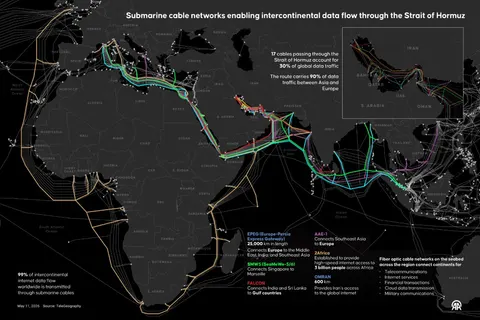
The Strait of Hormuz and the Convention of Montego Bay
By
Jean-Patrick Dayras
Published

The terms of the ceasefire agreement – set to last for a limited period of two weeks – remain, as presented unofficially, ambiguous. Iran is reported to have agreed to reopen the Strait of Hormuz, described as a major concession in exchange for the ceasefire. The strait meets the criteria defined by the 1982 United Nations Convention on the Law of the Sea as an international strait. Section 2 of the Convention outlines the definition of an international strait and sets out the rules governing the passage of ships through its waters and the overflight of aircraft above it. Article 37 “This section applies to straits which are used for international navigation between one part of the high seas or an exclusive economic zone and another part of the high seas or an exclusive economic zone.” Article 38 – Right of transit passage “1 – In straits referred to in article 37, all ships and aircraft enjoy the right of transit passage, which shall not be impeded (…).” “2 - Transit passage means the exercise in accordance with this Part of the freedom of navigation and overflight solely for the purpose of continuous and expeditious transit of the strait between one part of the high seas or an exclusive economic zone and another part of the high seas or an exclusive economic zone.” The term “reopening” could have serious implications for the future of navigation and passage through the strait for all non-Iranian or non-Omani vessels. It implies that the strait was closed and will now be reopened by Iran. In other words, it suggests that the strait belongs to Iran, which can shut or open it at will – or manage it jointly with Oman. This would effectively mean that the Strait of Hormuz is no longer treated as an international strait, and its use could be subject to fees or obligations, including the requirement to pay a transit fee. Such a scenario would have significant repercussions for shipping costs across the Arabian-Persian Gulf. Such a situation could then be replicated elsewhere: the Bab-el-Mandeb, Malacca, Lombok, the Sunda Strait, Gibraltar, why not, as well as the Dardanelles, the English Channel, Russia’s northern coast – which is already being considered by that country – and even the Northwest Passage. All are international straits and passages vital for global trade and maritime traffic. Would it not have been wiser to use alternative wording, such as “lifting the blockade of the Strait of Hormuz” or “halting threats to block the Strait of Hormuz,” or any other formulation that clarifies that Iran had taken actions contrary to the Convention and the definition of an international strait? If the negotiators have indeed used the phrasing currently being reported – let us hope that is not the case – it is likely because the Iranians, perhaps more clear-sighted than their counterparts, have a medium to long-term plan in mind. One can only hope they do not. * Jean-Patrick Dayras: Rear Admiral in the French Navy; naval aviation pilot; specialist in air-sea operations and commando interventions; former expert for the International Maritime Organization (IMO).

Lebanese Impressionism: César Gemayel, a Pioneer Between Two Worlds (3/4)

A key institutional figure and a major painter, César Gemayel stands as one of the pillars of modern painting in Lebanon. His career is defined by a transition from rigid, static academicism to a more sensuous and Oriental form of expression. He helped shift Lebanese art from purely religious or documentary forms toward a more personal expression, transforming traditional Lebanese forms of art into a modern visual language shaped by Impressionist and Parisian influences. The Man César Gemayel was born on February 9, 1898, in Aïn el-Touffaha, a small village in Mount Lebanon near Bikfaya, then under Ottoman Empire, into a family of notable standing. He initially pursued religious studies at the seminary in Kornet Chehwane, which he left following his father’s death to turn to pharmacology studies at the American University of Beirut. The Artist’s Beginnings Gemayel’s destiny took a decisive turn when he crossed paths with the painter Khalil Saleeby, a leading figure in Lebanese art. Impressed by his drawings, Saleeby took him on as an apprentice in his studio, where Gemayel developed exceptional technique. He soon abandoned pharmacology to dedicate himself fully to painting. In 1927, he left for Paris, where he attended the Académie Julian and the École des Beaux-Arts, two institutions that had trained renowned artists such as Matisse, Bonnard, and even Gibran Khalil Gibran. He spent three years studying the Parisian painting of the 1920s and 1930s up close, including Impressionism, Post-Impressionism, and Fauvism, showing a particular fondness for Fauvism and Impressionism. During this time, he developed a deep admiration for Renoir’s luminous palette. This Parisian period proved crucial in his development, with all these influences helping to liberate his palette and shaping his mature style. The Years of Maturity In 1930, Gemayel returned to Beirut. The following year, he was awarded first prize at the Paris International Colonial Exhibition and received the National Order of the Cedar. Emboldened by these distinctions, he decided to devote himself entirely to his art. During this period, Lebanon experienced a cultural effervescence, fueled by patrons such as Alfred Sursock, Omar Daouk, Henri Pharaon, and Camille Eddé. Until his death from a heart attack in Beirut in 1958, César Gemayel continued to paint, teach, and play an active role in Lebanon’s artistic life. In 1943, he co-founded the Department of Art and Architecture at the Lebanese Academy of Fine Arts (ALBA), where he taught, thus taking on a pivotal cultural role in the country’s intellectual independence and helping to structure art education in Lebanon. The Painter of Body and Land A hedonist of color, Gemayel managed, in both his portraits and landscapes, to capture Lebanese identity without slipping into folklore. His painting is characterized by vigorous brushwork and thick layered paint. Across his works, he privileged visual emotion over photographic detail. If Omar Onsi was the master of light and transparency, César Gemayel established himself as the master of the nude. This is arguably the boldest facet of his oeuvre. In a still highly conservative society, he introduced the academic nude, painting his models with a generous, almost sculptural sensuality. As for light and the Lebanese landscape, unlike Orientalist painters who reduced the Orient to mere exotic scenery, Gemayel rendered them with visceral intensity, with a sincerity and physical “fleshiness” that feel almost palpable. His Struggles Throughout his life, Gemayel faced the tension between tradition and modernity. At certain exhibitions, his nudes sparked controversy. Yet his technical mastery earned him the respect of both the elite and the clergy, paving the way for greater artistic freedom for future generations. In doing so, he introduced the nude and corporeal realism to the Middle East, exerting a major influence on Lebanese artists such as Shafic Abboud and Paul Guiragossian. In 1988, on the centenary of his birth, Lebanon paid him a national tribute, a testament to his enduring status as the definitive reference for Lebanese aesthetics in the 20th century. Even today, his works can be admired in prestigious institutions such as the Sursock Museum, Mathaf in Doha, and the Dalloul Art Foundation. An Iconic Work: “Nude in Repose” The nude is a recurring and emblematic theme in Gemayel’s work, whether in oil on canvas or charcoal sketches. His nudes are alive, rendered with a vibrant palette. He favors warm skin tones and does not hesitate to introduce subtly colored shadows. Under his free, expressive brush, the skin seems to quiver and breathe. The painting Nude in Repose perfectly illustrates his avant-garde sensibility and technical virtuosity. By concealing the model’s face, Gemayel directs the viewer’s full attention to the play of light across the skin. His fluid, liberated brushstrokes trace the curve of the back and spine, in the pure tradition of French Impressionism and painters such as Renoir. In Gemayel’s hands, voyeurism becomes gentle and poetic, never shocking. The model’s languid pose exudes a profound sensuality while maintaining a sense of modesty. Anatomy is idealized, and the elongated, softened lines prioritize the overall harmony of the composition. Beyond technique, exhibiting the nude female body – even from behind – in the 1930s and 1940s was a revolutionary act. Through his canvases, Gemayel directly challenged the taboos of his society, asserting artistic freedom and elevating the Lebanese art scene to the level of avant-garde Western movements. Next article Lebanese Impressionism: Moustafa Farroukh, Painter and Committed Intellectual Read on the same topic – Lebanese Impressionism: From Parisian Greyness to the Light of Mount Lebanon (1/4) – Lebanese Impressionism: Omar Onsi, Master of Light (2/4)

Netanyahu’s Surprise Move: Open to Direct Talks with Beirut

In a surprise move late Thursday, April 9, Israeli Prime Minister Benjamin Netanyahu announced, following a meeting of the country’s security cabinet, that he had instructed his government to initiate direct negotiations with Lebanon without delay. He also took the opportunity to publicly welcome a decision by his Lebanese counterpart, Prime Minister Nawaf Salam, whose cabinet, meeting Thursday at Baabda Palace, approved a resolution mandating the Lebanese army and security forces to prohibit any illegal armed presence in the Beirut governorate. The move effectively seeks to enforce the principle of the state’s monopoly over arms. This surprise decision by Mr. Netanyahu came in the wake of several significant developments over the past twenty-four hours. It was announced a day after a phone call on Wednesday evening between President Donald Trump and the Israeli Prime minister. Reports emerging from Tel Aviv on Thursday afternoon indicated that the White House had urged Mr. Netanyahu to “somewhat reduce” the intensity and scope of strikes in Lebanon. It is highly likely, however, that the prospect of direct negotiations with Lebanon was central to the conversation. Another notable development on April 9 came in remarks delivered at the opening of a cabinet meeting by President Joseph Aoun, who stressed that “only Lebanon can negotiate on behalf of Lebanon, and it is inconceivable that any third party should seek to do so.” Lebanon’s Foreign Ministry had already taken a similar stance several days earlier, drawing sharp criticism from circles close to Hezbollah. In any case, during Thursday’s cabinet meeting, the Prime minister sought approval for a decision tasking the army and security forces with concretely enforcing, in the Beirut governorate, the principle of the state’s exclusive monopoly on arms. Ministers from the Shiite Hezbollah-Amal duo strongly opposed Mr. Salam’s request, and heated exchanges were reported between the two sides. Ultimately, however, the Prime minister’s position prevailed, backed by ministers from the Lebanese Forces, the Kataeb Party and other sovereignty-aligned figures. At the close of the cabinet session, Mr. Salam personally and solemnly announced the decision to demilitarize the Beirut governorate, specifying that the resolution was in line with the provisions of the Taif Agreement and with previous decisions already taken by his government in this regard. It is worth recalling in this context that President Joseph Aoun has repeatedly called, over the past few weeks, for direct negotiations with Israel – much to the chagrin of Hezbollah and the Amal Movement. The initiative by Lebanon’s head of state had previously been rejected by the Israeli Prime minister. However, the unfolding developments in the Iran war, and likely Wednesday’s intensive raids targeting Hezbollah officials and positions in the heart of Beirut, as well as in Saida, the Bekaa, and Hermel – around a hundred strikes in ten minutes – appear to have had the indirect effect of prompting Mr. Netanyahu to give the green light for direct talks with Lebanon. At the State Department, with Washington as Guarantor In practice, information available Thursday evening indicated that direct Israeli-Lebanese talks are set to take place in the coming days – possibly as soon as next week – at the State Department, with Washington acting as guarantor for the smooth conduct of the negotiations. The Israeli delegation will be led by Israel’s ambassador to Washington. As for the Lebanese delegation, some sources said Thursday evening that it would be headed by former ambassador Simon Karam, while others reported that Ambassador to Washington Nada Hamadé Moawad would lead the negotiating team. Regarding the agenda for the talks, Mr. Netanyahu indicated that it would focus on “the disarmament of Hezbollah and peace between Lebanon and Israel.” For now, Beirut is demanding that at least a provisional ceasefire serve as a prelude to these negotiations – something the Israelis do not appear willing to accept. The big unknown, in light of this surprise move, is the reaction of the Iranian camp – specifically the Islamic Revolutionary Guards and their armed wing in Lebanon. It is worth noting that, prior to the announcement of the upcoming direct talks with Israel, the Israeli air force continued its strikes Thursday against several villages in southern Lebanon, with the main objective of the ongoing battle seemingly being control of the strategically important town of Bint Jbeil.

Lebanon and “the Day After”
By
Élie Hajj
Published

“When will the war end? I say: when we meet again.” Mahmoud Darwish I am by nature an optimist, without being armoured against sadness. Yet, despite the darkness and brutality of the war, I find myself living through one of the most hopeful periods of my life — contrary to many around me. I believe we are witnessing Lebanon’s last wars, and in the quiet of the night my thoughts drift toward “the day after the war.” I think, with genuine compassion and without seeking to blame anyone, in near-total neutrality, about the shock that will strike households whose members were raised in a deep hatred of Israel, its people, and Jews in general — Arab nationalists, Syrian nationalists, communists, Islamists of every stripe. Those who cannot bear to hear the word “Israel” and replace it with the “Zionist entity” or the “occupied and temporary entity”; those who once preferred — and some still do today — to burn Lebanon rather than abandon the liberation of Palestine, raising the banner of “freedom of armed Palestinian action across all Lebanese territory,” forcing their own state to surrender its sovereignty through the “Cairo Agreement,” as a sacrifice to the Palestinian cause. How will they bear a new reality in which Israel will not withdraw from Lebanon this time except through a comprehensive peace agreement? In which there can be no return to the 1949 armistice, but rather strict and binding security arrangements designed to guarantee the safety of its northern border forever? A heavy price Lebanon will be forced to pay to recover its land To those who ask me these days, I say: when the hour of genuine negotiation arrives, there will be “weeping and gnashing of teeth.” The price we will have to pay, if we wish to restore the land and people of the South to the Lebanese state, will be steep. Once more, read the text of the 1983 Israeli withdrawal agreement, which you scorned by naming it “May 17” or “the accord of humiliation and shame” — the same accord you brought down through the uprising of 6 February 1984. Read it again, wish fervently, and pray that Israel will agree to something resembling it after the war. My intuition, borne out by every visible sign, tells me it will not. This time, Israel will no longer settle for a conditional withdrawal or fragile security arrangements susceptible to being undone by suicide operations; sustained and sporadic attacks against its occupation forces will no longer be possible. The Assad regime no longer exists to support the “resistants” and cover their flanks; the theocratic Iranian regime is tottering; the Soviet Union has long since dissolved; and the land, now emptied of its inhabitants, no longer resembles what it once was — the people of that territory are the water without which the fish of resistance cannot survive. Israel will demand permanent guarantees and genuine international monitoring mechanisms in which it will participate and which it will oversee — or, at best, that role will fall to the armies of the United States and the Arab nations hostile to the Iranian regime. Foreign powers may even impose radical transformations in the very structure of the Lebanese state, so that the South does not once again become a launchpad for rockets fired at northern Israel, or a network of tunnels from which to strike it. Those who built their identity upon “the Islamic resistance in Lebanon” will discover that this chapter has definitively closed, and that the Khomeinism they had embraced as a faith and a way of life now belongs to another era — a crushing burden for themselves, their families, and Lebanon as a whole, one that will be impossible to carry. They will confront a bitter reality: Palestine has not been liberated, Lebanon has paid the full price, and Israel has not been defeated — on the contrary, it now finds itself in a position to impose its own terms. The Lebanese will then understand that those who set Beirut ablaze repeatedly, who devastated the South time and again, are the very same people who today oppose any political solution capable of sparing the country a renewed catastrophe. But the day I speak of will not be one of revenge or mockery. It will be the day of an encounter grounded in the shared conviction that the wager on liberating Palestine at the expense of Lebanon’s existence was a grave mistake. What happened is that we were already living the Palestinian tragedy, and now we find ourselves immersed in the Palestinian and Lebanese tragedy together, having gained nothing but destruction and grief, at the cost of sons and daughters whose young lives were cut short for nothing. A day on which the Lebanese will acknowledge that the peace reached by sister Arab nations was not a betrayal, but the best of what was possible — the only choice that preserves what remains of our country and our state. A peace that means secure borders, a state capable of exercising its sovereignty fully, an economy open to the world rather than closing in on itself under the slogans of “resistance.” That day will mark the beginning of a truly new era. An era in which Lebanon emerges from the cycle of endless, chained wars fed since 1969 by the illusions of “the central cause” and “armed resistance to the last breath.” An era in which the Lebanese recover their right to an ordinary life: building their homes, cultivating their land, raising their children far from the sound of explosions, airstrikes, rockets, and fiery speeches. It will not be easy, for a generation raised in the conviction that “Israel is the enemy forever, and we must struggle without respite, whatever the losses, to erase it from the map from the river to the sea,” to wake suddenly to a world in which this “enemy” will not leave except after signing a weighty agreement designed precisely to protect it. But history shows no mercy to those who remain prisoners of the past, and the day after the war will be, whatever the outcry and whatever the cost, the day of those who chose Lebanon first — whether they arrived at that choice early or late — to rebuild together and heal the wounds of the homeland and of souls.

Mohammed Hussein Shamseddine, that Unknown Soldier

If I write these words today, it is not out of ethics, friendship, or politeness, but out of the immense respect I hold for a man who gave so much to Lebanon and who remained an unknown soldier. This man's name is Mohammed Hussein Shamseddine, and from 1992 to 2026 he thought and drafted the majority of the political literature that formed the cornerstone upon which we built the narrative of this country's sovereignty and independence. For Mohammed Hussein Shamseddine, sovereignty and independence were always bound to national unity, upon which they directly depended. And whenever that national unity was broken, whatever the reason, it inevitably brought with it a rupture in the country's independence and sovereignty. He would say that the majority of Lebanese — communities and parties alike — had chosen, in order to settle scores with other communities and parties, to forge a partnership with a regional or foreign power, ceding to it a portion of the country's sovereignty in exchange for auxiliary force to be used internally against the differing other. For him, independence and sovereignty were indivisible, and no benefit could be created at the expense of partnership with the other communities, whether different or not. Chamseddine was an unknown soldier because the credit for drafting, for instance, the literature of the Permanent Congress of Dialogue had been attributed to great thinkers. The credit for drafting the entire literature of Qornet Chehwan, of March 14, of the general secretariat, of the political manifestos drawn up each year, of the letters addressed abroad, to Arab decision-making centers, and so on, had all been attributed to great thinkers. All of that national and political heritage was, in truth, owed to the thinking of Mohammed Hussein Shamseddine. It was around him that we would gather at the general secretariat, cigarette in hand, with a river of coffee served by Antoinette. Around this sage, this profoundly modest man who had never, unlike so many politicians and political thinkers, sought to make a display of what he knew at another's expense. On the contrary, he taught, calmly, as a sage does. Around him, everyone — everyone — listened, seeing in him a source of kindness, courage, common sense, intelligence, and above all a deep understanding of the complexity of Lebanese society. Mohammad, you will remain for me, always, as Sami Frangieh or Nassir al-Assad were before you, a man of learning from whom I learned to stay modest, to read intensely, and to see and know Lebanon in a different way. Lebanon, as you always said, cannot be built on a balance of power, but on the power of balance. May you be heard, especially in these terrible moments we are living through, and may your words and your thought become the philosophical pillar of the Lebanon of tomorrow.