
Levant Time logo

Articles

News feature image
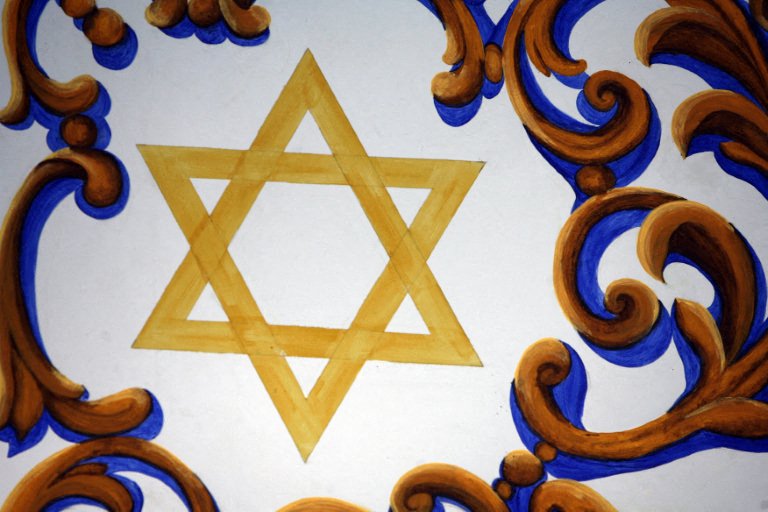
The Star of David painted on a wall inside the Magen Abraham Synagogue, ocated in the former Jewish quarter of Wadi Abu Jamil, in Beirut (Photo JOSEPH EID/AFP).
Society
Author portrait
By Makram Rabah
Published Oct 25, 2026 - 01:06
Lebanon’s claim to be a refuge must be measured by its ability to protect the right of all its citizens to live freely, without concealing their identity, justifying their presence or repeatedly proving their loyalty. When a community leaves because its members can no longer imagine a safe future at home, Lebanon loses part of its meaning and its capacity to accommodate difference. Rhetoric about diversity and coexistence cannot compensate for that failure. These questions shaped the discussion of Nada Abdel Samad’s book, When the Jewish Balconies of Wadi Abu Jamil Went Dark , at the American University of Beirut, organized by the Department of History and Archaeology and the History and Archaeology Student Society. The gathering confronted what we often prefer not to see: how a Jewish neighborhood disappeared from public memory, and how a Lebanese community’s departure became a footnote, despite what it reveals about our society, our state and our political discourse.
Strategia
Author portrait
By Khalil Helou - Published Oct 24, 2026 - 23:36
News feature image
An Orthodox choir takes part in a procession during celebrations on the eve of the Ethiopian festival of Meskel, equivalent to the Feast of the Cross in the Levant, in Addis Ababa, Ethiopia’s capital. (AFP)
Since April 2023, the conflict between the Sudanese Armed Forces (SAF), commanded by General Abdel Fattah al-Burhan, and the Rapid Support Forces (RSF), led by General Mohamed Hamdan Dagalo, known as “Hemedti,” has plunged Sudan into a destructive spiral. By October 2026, this civil war had become the world's worst humanitarian crisis. The country's strategic position, where the Red Sea meets the Nile Basin, combined with its vital mineral resources, particularly gold, makes it a major geopolitical linchpin. The prolonged collapse of state institutions threatens stability across the Horn of Africa and the Sahel, intensifying international security concerns.
Decryption

United States - Iran, the war of last resort?

Signs of renewed hostilities as “Iranians struggle to feed themselves”
Author portrait
By LevantTime . - Published Oct 24, 2026 - 23:25
News feature image
A masked Iranian portrays US President Donald Trump inside a symbolic prison cell installed on a billboard in northern Tehran, Iran. (AFP)
Bellicose statements from senior U.S. officials, followed by the deployment of substantial naval forces to the region, warnings to American citizens in the Gulf, and a heightened state of alert among Israeli forces, whose air force has conducted “maneuvers” near Iran’s borders… The United States appears to be preparing to resume large-scale strikes against Iran. For several weeks, Washington and Tehran have been confronting each other primarily at sea: the United States is blockading Iranian ports, while the Islamic Republic is trying to exert control over the strategic Strait of Hormuz. Neither country has launched a major attack on land targets since early September, but that could soon change.
More Articles
Sort By: NewestOldest
Barbarism Mourns Rifaat al-Assad
By
Khairallah Khairallah
Published

Rifaat al-Assad, who passed away a few days ago, on January 20, 2026, embodied one of the most revealing faces of Syria’s great transformation toward what may rightly be called a “State of Barbarism”: a state whose claimed legitimacy rested on repression, enforced communal ʿasabiyya , and the relentless pursuit of an “alliance of minorities.” This transformation effectively began with the Syrian-Egyptian union of 1958, a fleeting experiment that survived barely three years and a few months. At heart, Rifaat al-Assad was no more than one cog among others within that Syrian State of Barbarism which he defended without reservation, long before the Hama massacre of February 1982 and through the invasion of the countryside into the cities. This enterprise sought to impose archaic values upon urban populations, in retaliation against everything Damascus, Aleppo, Homs, Hama, and Latakia embodied as civilizational values.

US Sanctions Reveal the Flaws of the Iranian Regime

« Totalitarian regimes are not content to dominate bodies; they seek to enslave minds. » – George Orwell Since the Iranian Revolution of 1979, the United States has imposed a large-scale economic sanctions regime on Tehran, which has become over the decades one of the most multidimensional pressure tools in American diplomacy. The first measures, instituted after the hostage-taking at the American embassy in Tehran in November 1979, froze Iranian assets in the United States via Executive Order 12170, immobilizing billions of dollars and blocking numerous financial operations. In the mid-1990s, Washington strengthened its arsenal: in March 1995, all American investment in the Iranian energy sector was prohibited; a measure followed in May by a total trade embargo covering almost all exchanges and technology transfers. The « Iran and Libya Sanctions Act » of August 1996 introduced extraterritorial sanctions, threatening foreign companies investing in Iranian hydrocarbons.

Union for the Mediterranean: What Has Lebanon Gained?
By
Jean-Patrick Dayras
Published

The latest article in our analysis of the evolution of the Euro-Mediterranean partnership of Barcelona (Euromed), then of the Union for the Mediterranean (UfM), draws an unvarnished assessment of the achievements and shortcomings that have marked, for Lebanon, the two phases 1995-2008 and 2008-2025 of this dual European strategic initiative. The Euro-Mediterranean Barcelona Process (Euromed), then the Union for the Mediterranean (UfM), have brought political, economic, and institutional achievements to Lebanon. However, these remain limited due to the chronic instability that has plagued the country since 1995, and more particularly since 2008.

Syria: From the Risk of Partition to the Challenge of the New State

In Syria, the question is no longer whether Bashar al-Assad’s regime could endure. That chapter is now closed. The real issue lies elsewhere. Can Syria, in the aftermath of the old regime’s collapse, rebuild a unified and viable state, or does the risk of disintegration and partition linger, merely taking on new forms? The fall of Assad’s regime at the end of 2024, followed by Ahmad al-Chareh’s rise to power during the transitional period, marked a major turning point in the Syrian landscape. While this upheaval did not, in itself, bring an end to the crisis, it profoundly reshaped its political contours. The debate has shifted from the fate of a regime to the very future of the state itself.

The economic and cultural impact of the Grand Egyptian Museum

In our previous articles, we briefly explored the construction of the Grand Egyptian Museum and highlighted its major role as a research center. We also reviewed some of the extraordinary treasures it houses. But what of its economic, cultural, and national significance for Egypt? One of the Grand Egyptian Museum’s (GEM) primary roles is undoubtedly economic. It aims to attract tourists from across the globe, thereby playing a central part in the country’s economic dynamism. Situated near the Giza pyramids, the GEM is a cornerstone of Egypt’s new tourism strategy, with the goal of drawing up to 30 million visitors annually by 2030. This would place it among the world’s most visited cultural institutions. Such an influx is expected to revitalize ancillary sectors such as hospitality, catering, transport, and even small local businesses, creating thousands of direct and indirect jobs.

Forget Rifaat al-Assad ?
By
Michel Hajji Georgiou
Published

If basic decency prevents us from rejoicing even at the death of a monster, it does not prevent a certain sudden lightness from being felt, or even a fleeting sense of relief, upon hearing the news. Rifaat al-Assad is dead. Faced with the retrospective and retroactive feeling of powerlessness and desolation in the face of the worst atrocities in history, one consoles oneself as best one can. Assad takes with him a part of the darkest memory of the contemporary Levant: cities crushed for having screamed too loudly against barbarity, neighborhoods razed to serve as examples. One need only read the testimony of Michel Seurat, who paid for it with his life, to grasp with dread how Hama and Homs, in 1982, became laboratories for Assad’s almost clinical experimentation with death. Lebanon too, from Tripoli to its humiliated margins, paid the price for Rifaat’s inhumanity through his militias, the so-called “Red Knights.”