
Levant Time logo

Articles

News feature image
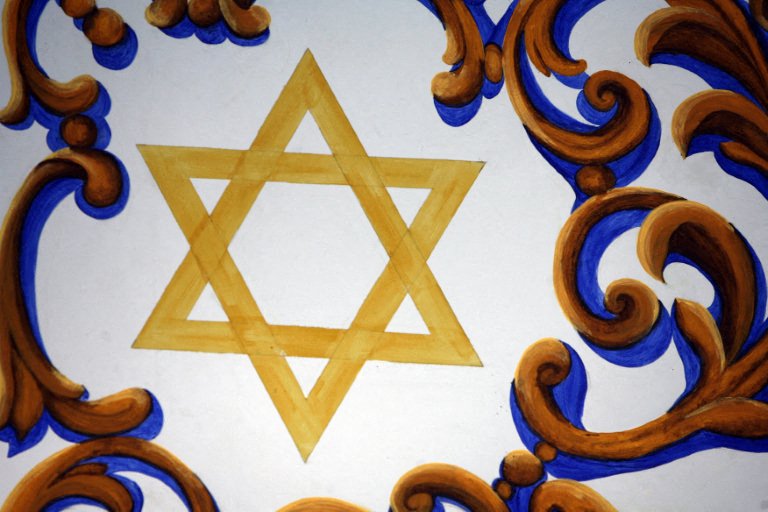
The Star of David painted on a wall inside the Magen Abraham Synagogue, ocated in the former Jewish quarter of Wadi Abu Jamil, in Beirut (Photo JOSEPH EID/AFP).
Society
Author portrait
By Makram Rabah
Published Oct 25, 2026 - 01:06
Lebanon’s claim to be a refuge must be measured by its ability to protect the right of all its citizens to live freely, without concealing their identity, justifying their presence or repeatedly proving their loyalty. When a community leaves because its members can no longer imagine a safe future at home, Lebanon loses part of its meaning and its capacity to accommodate difference. Rhetoric about diversity and coexistence cannot compensate for that failure. These questions shaped the discussion of Nada Abdel Samad’s book, When the Jewish Balconies of Wadi Abu Jamil Went Dark , at the American University of Beirut, organized by the Department of History and Archaeology and the History and Archaeology Student Society. The gathering confronted what we often prefer not to see: how a Jewish neighborhood disappeared from public memory, and how a Lebanese community’s departure became a footnote, despite what it reveals about our society, our state and our political discourse.
Strategia
Author portrait
By Khalil Helou - Published Oct 24, 2026 - 23:36
News feature image
An Orthodox choir takes part in a procession during celebrations on the eve of the Ethiopian festival of Meskel, equivalent to the Feast of the Cross in the Levant, in Addis Ababa, Ethiopia’s capital. (AFP)
Since April 2023, the conflict between the Sudanese Armed Forces (SAF), commanded by General Abdel Fattah al-Burhan, and the Rapid Support Forces (RSF), led by General Mohamed Hamdan Dagalo, known as “Hemedti,” has plunged Sudan into a destructive spiral. By October 2026, this civil war had become the world's worst humanitarian crisis. The country's strategic position, where the Red Sea meets the Nile Basin, combined with its vital mineral resources, particularly gold, makes it a major geopolitical linchpin. The prolonged collapse of state institutions threatens stability across the Horn of Africa and the Sahel, intensifying international security concerns.
Decryption

United States - Iran, the war of last resort?

Signs of renewed hostilities as “Iranians struggle to feed themselves”
Author portrait
By LevantTime . - Published Oct 24, 2026 - 23:25
News feature image
A masked Iranian portrays US President Donald Trump inside a symbolic prison cell installed on a billboard in northern Tehran, Iran. (AFP)
Bellicose statements from senior U.S. officials, followed by the deployment of substantial naval forces to the region, warnings to American citizens in the Gulf, and a heightened state of alert among Israeli forces, whose air force has conducted “maneuvers” near Iran’s borders… The United States appears to be preparing to resume large-scale strikes against Iran. For several weeks, Washington and Tehran have been confronting each other primarily at sea: the United States is blockading Iranian ports, while the Islamic Republic is trying to exert control over the strategic Strait of Hormuz. Neither country has launched a major attack on land targets since early September, but that could soon change.
More Articles
Sort By: NewestOldest
Sudan's Collapse: War for War's Sake (1/4)
By
Michel Hajji Georgiou
Published

An analytical focus on the war in Sudan which, since 2023, has already resulted in tens of thousands of deaths and millions of displaced people, with a particularly overwhelming human cost in Darfur, where mass violence, sieges, and forced displacement have taken on a dimension that many international actors now qualify as genocidal. Sudan did not collapse all at once. It unravelled in successive layers, to the rhythm of a war that aims neither at the lasting seizure of power nor the reconstruction of a political order, but the gradual exhaustion of what still remains of the state. Since April 2023, violence has established itself there as a regime in itself, transforming the country into a fragmented space where the long duration of the conflict counts more than any specific military victory.

The Louvre Abu Dhabi, at The Heart of The «Soft Power» of the United Arab Emirates (1/2)

The Louvre Abu Dhabi is a universal art museum located on Saadiyat Island, the aptly named 'Island of Happiness', which aims to become the new cultural center of the UAE. With its temporary exhibitions co-organized with major French museums and its 'universal' discourse, the museum contributes to the soft power of the United Arab Emirates and to the redefinition of the Arab world's place in international art and heritage circuits. The origins The Louvre Abu Dhabi is the result of an intergovernmental agreement between France and the United Arab Emirates, which allows the latter to use the name "Louvre" until 2047.

Humanitarian Intervention in Tehran and Self-Defense in Caracas!

Who did not welcome the removal of Nicolás Maduro, the dictator who forced eight million of his compatriots, or a quarter of Venezuela's population, into exile? But does this mean that the American administration was within its rights in carrying out this audacious raid in the vicinity of Caracas? According to the 1945 United Nations Charter, which enshrines national sovereignty and guarantees peace between nations, a country can only resort to armed force in two cases: self-defense and the adoption of a Security Council resolution authorizing it. A country can, however, intervene in the territory of another to respond to the urgent request of its legitimate government: Wasn't it that US Marines landed on our shores in 1958 at the request of President Camille Chamoun?

Anatomy of an Anomaly: Thawra or Mere Spasm?

The brutal repression unleashed by the mullahs and the Pasdaran to neutralize the courageous revolution of Iranian citizens bears the hallmarks inherent to every dictatorship. More than 30,000 dead, 40,000 imprisoned whose fate remains unknown, an incalculable number of missing persons—and the figures will only rise as the macabre truth gradually comes to light. Very quickly, terror replaced the long-awaited hope for change. Order seems to reign once again, but at what price—and above all, for how long? In the absence of a united opposition, the medieval and corrupt dictatorial regime has free rein to set fire to and spill the blood of anything that moves. Methodically, viciously, savagely, without the slightest scruple. The only lifeline to which the majority of Iranians cling remains a possible American intervention, though no one knows in advance what its consequences might be, either internally or regionally.

The Planned Demise of the Third Power
By
Jawad Pakradouni
Published

A dark corridor, the smell of dampness emanating from it, a broken or unpowered elevator, dirty stairs, then another dark corridor, strewn with coffee cups whose grounds have splashed the floor, empty water bottles, crushed cigarette butts... There, in an office plunged into darkness, a rickety chair awaits its occupant, who settles in, waiting for the generator to deign to light up the premises. Then there was light, revealing the decrepitude. This is not the setting of a post-apocalyptic film, but indeed that of the Palace of Justice in the city that the poet Nonnus of Panopolis, in the 5th century, named guarantor of order and mother of laws: Berytus Nutrix Legum.

The Ontological Decompensation of Hezbollah
By
Michel Hajji Georgiou
Published

Every twenty years, a gambler arrives, who stakes the country, its people, its inheritance, sunrises and sunsets, boys and girls, waves and sea on a poker table. Nizar Qabbani Thus, Naïm Qassem seeks to sacrifice Lebanon for Iran. After sending his followers to die for Assad’s Syria, after allowing the inhabitants of his revolutionary home to be atomized for Hamas, he now seeks to conclude in style, through a collective suicide, at a moment when the Iranian mother-house itself is under threat, facing the supposedly invincible armada deployed by Donald Trump in the waters of the Middle East. The latest statements by Hezbollah’s Secretary-General might almost pass for the bravado of a hardened strongman—and perhaps they still do for part of his flock, weaned on the myth of the Aryan Übermensch manufactured by Iranian clerics. Yet this so-called “bravery”—once acknowledged in the late 1990s by the vast majority of Lebanese when it came to defending Lebanese territory against Israeli occupation—has since degenerated into strategic suicide, even if the word “strategic” itself now sounds grotesque in this context.