
Levant Time logo
Mona Fayad

Mona Fayad

Framework Agreement: When Iran Shifts the Pressure to Lebanon
By
Mona Fayad
Published
Jul 3, 2026 - 17:33

A researcher in biophysics once wrote: “I do not read power solely through politics; I also read it through matter. In the laboratory, we learn a truth that people recognize from everyday life: pressure does not affect every material in the same way. Apply pressure to glass and it may shatter. Apply it to rubber and it bends. Apply it to living tissue and it may absorb the pressure, adapt to it, and repair itself. The very same force may destroy one structure while strengthening another. The difference lies not only in the pressure itself, but in the internal structure that receives it.” This is precisely where Israel’s and the United States’ reading of Iran, and of the Middle East more broadly, falls short. Like every power that places supreme confidence in its technological superiority, Israel assumes that history can be engineered through pressure: strike harder, kill more, tighten sanctions, deepen isolation, and the adversary will eventually retreat. Yet this is a mechanical reading of human societies. It imagines nations as inert objects that, if subjected to sufficient pressure, will inevitably break.

The victory speech and the commerce of illusions
By
Mona Fayad
Published
Jun 22, 2026 - 16:37

A citizen from the South commented on the return of the displaced as follows: "If you return… return in a silence worthy of what has happened, not in a clamor that wounds what little life remains." "Do not raise victory signs over a land whose tears have not yet dried, and do not wave flags where dust still obscures the faces of those not yet pulled from the rubble." "Return… but shed the arrogance of slogans from your shoulders, for this is not a stage for celebration — it is a field of open graves…" If one follows the statements of Naim Kassem, who now appears more than once a week, one would think he had won a victory, defeated Israel, and liberated Lebanon. He therefore feels entitled to accuse the President of the Republic and the Prime Minister of treason and collaboration, and to demand the fall of a government from which he nonetheless refuses to withdraw his own representatives.

When the Hezb Recruits Children and Justifies It...
By
Mona Fayad
Published
Jun 17, 2026 - 13:08

When Hezbollah, or those orbiting within its sphere, are questioned about their practice of recruiting children — a category that UNICEF defines precisely, through the Convention on the Rights of the Child, as any human being under the age of eighteen — the answer invariably moves between a few registers: they claim the children want it themselves, that they are mature enough, or that it is perfectly normal and consistent with the practice of every revolution in history. A rosary of references then unspools, carrying us back several centuries. We find ourselves, at once, mired in countless fallacies.

The Hezb's Hegemony Through Censorship and Sanctions
By
Mona Fayad
Published
Jun 11, 2026 - 11:36

When I recalled the substance of George Orwell's 1984 and Albert Camus's The Stranger , I sensed a certain thread connecting their respective descriptions of the instrument of control — or rather the general framework of domination — and what has been unfolding in Lebanon, particularly in recent years, since power consolidated itself in Hezbollah's hands and under its command. There is a strange convergence between the worlds of Orwell and Camus, despite their apparent differences: the world of external oppression in Orwell, and the world of absurdity and existential detachment in Camus. In Orwell, the individual is subject to absolute external surveillance. Big Brother does not merely monitor behaviour; he attempts to seize control of consciousness itself. The objective is not simply compliance, but the erasure of any possibility of internal dissent. Freedom is threatened from without, and the individual — Winston — seeks to reclaim his own selfhood through rebellion.

Lebanon: When Geography Becomes a Liability
By
Mona Fayad
Published
Jun 5, 2026 - 23:01

One increasingly hears voices lamenting their fate: why were we born in this corner of the world? For Lebanon's geographical position has placed it, today, in a situation that few would envy. Geography is not a blind destiny, and yet it constitutes a rigid framework that delimits the field of the possible and narrows the margin for error. In geopolitics, as Robert D. Kaplan reminds us in The Revenge of Geography , geography does not dissolve behind slogans; it reasserts itself whenever states choose to ignore it, and most acutely for small states situated on fault lines. Lebanon is one of them, caught between two powerful neighbours: one a vast military garrison housing one of the largest armies in the world, backed by the United States, and one that we helped restore to its occupation of Lebanon; the other having already exercised prolonged domination and a heavy-handed tutelage over Lebanon under the authoritarian Assad regime.

Between Discipline, Silent Resistance, and the Beginnings of Revolt
By
Mona Fayad
Published
Jun 1, 2026 - 05:58

The publication of two appeals launched by activists in Tyre and Nabatiyeh, addressed to the Lebanese State calling for the protection of these two ancient cities from the Israeli threat to erase them, for the deployment of the army and security forces within them, and for their designation as open, demilitarised cities, constituted the first public and organised act of resistance from within the Shia milieu. A milieu whose voices calling for the overcoming of fear and the raising of dissent have multiplied in recent times, against those who have confiscated its history, its present, and its future in vengeance for Khamenei. These activists were subjected to a campaign of threats, denunciation, and character assassination that led some to withdraw.

Is our problem really with Hezbollah’s doctrine?
By
Mona Fayad
Published
May 27, 2026 - 21:38

A widespread view in Lebanon holds that the Lebanese quarrel with Hezbollah stems from its doctrine and its adherence to the wilayat al-faqih as theorised by Khomeini. But the question deserves to be framed differently: does the problem truly lie in the doctrine itself, whether one agrees with it or rejects it, or rather in the imposition of that doctrine and the practices it entails upon society as a whole and upon the State? We have no right whatsoever to object to what others believe, nor to contest their full right to embrace whatever ideas and convictions they choose, whatever these may be. Any individual or community is free to forge its own intellectual and spiritual vision of the world, whether religious or political. This falls within the domain of freedom of conscience, a freedom enshrined in the Lebanese Constitution, one that is not, in its very essence, open to debate, nor should it be.

When Resistance Becomes a Forbidden Question
By
Mona Fayad
Published
May 19, 2026 - 15:16

There are certain keywords whose mere utterance is enough to put your interlocutor from the camp of the Momana’a on alert: the moment one pronounces “Palestine,” “resistance,” “America,” or “Israel,” something triggers within him, a kind of mental switch, and he stiffens to the point where any calm, objective discussion becomes impossible. The problem in Lebanon today is no longer that of divergent opinions, but rather the absence of the thinking process itself. Ready-made positions are summoned instantly, discourses repeated unchanged, choices maintained in spite of everything that shifts around them. As though we never questioned ourselves, never re-evaluated anything, never asked: are we still genuinely thinking about what we are doing, or are we merely repeating what we have grown accustomed to, simply because it has become part of our identity? This is precisely where the danger begins, when repetition substitutes itself for thought.

"We Want to Uproot You"
By
Mona Fayad
Published
May 8, 2026 - 12:13

When I used to travel to Canada, I was always provoked by Israeli propaganda that claimed falafel, tabbouleh and hummus as part of traditional Jewish-Israeli heritage. It was an appropriation of culinary traditions that have belonged to the Levant for centuries, and not merely the theft of a patrimony: it was the confiscation of an identity and a memory. No people in history has invested in memory as the Jews did in the aftermath of the Holocaust. They built one of the most powerful systems of memorial preservation the world has ever seen, turning memory into a total apparatus: material, pedagogical and legal, designed to be indelible. They catalogued personal belongings in museums, gathering thousands of objects that had belonged to the victims: shoes, bags bearing the names of their owners, eyeglasses, hair shorn from prisoners, clothing and small personal items (combs, watches, rings); all in order to attest that the victims were real individuals, and not merely numbers.

When Theft Becomes a “Gap”
By
Mona Fayad
Published
Apr 30, 2026 - 20:43

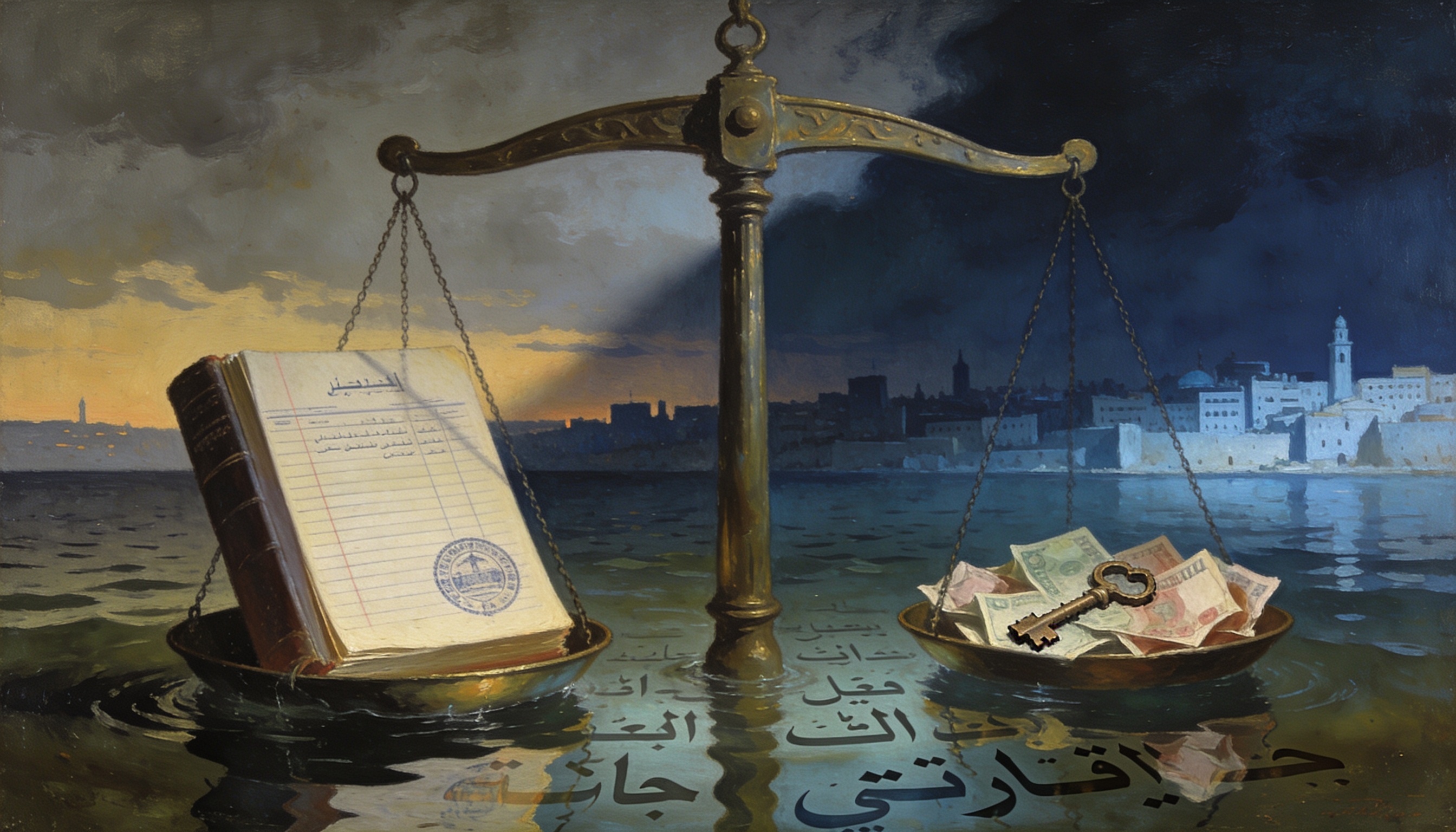
Lebanon did not collapse because of a flaw in the numbers, but because meanings and values fell apart. Suddenly, the money stolen from ordinary people was no longer called theft, but a “financial gap.” There were no longer any responsible parties, only “losses.” And there were no longer any victims, only “depositors” who were being asked to understand the circumstances and share in bearing the cost. This is not merely a matter of language. It is the very heart of the battle. When a crime is reduced to an accounting term, the debate becomes technical rather than ethical and legal. The issue is removed from the arena of justice and transferred to that of management, shifting from “who stole?” to “how do we distribute the loss?” And here begins the great slide: the victims gradually transform from rights holders into actors in the solution, rather than bearers of rights.